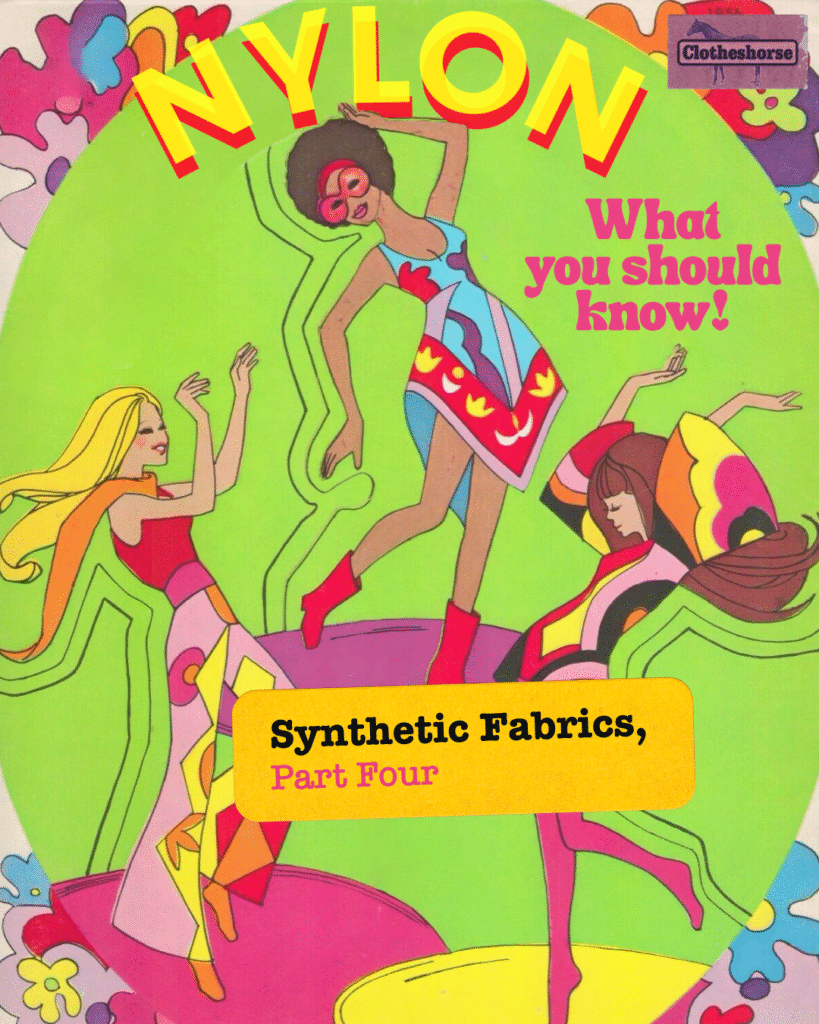
This is part three in an ongoing series about fabric. Find other parts of this series in the Slow Fashion Resource Center.
As a person who wears a dress almost every single day (which requires tights during cooler weather), learning the truth about nylon was particularly painful. Definitely one of those moments where ignorance was not particularly blissful (because who gets super excited by tights), but at least it was far less depressing and stressful?
But like a lot of the depressing/infuriating/terrifying things I have learned and discussed on my own Clotheshorse journey, where there is knowledge, empowerment follows.
Now that I know that the production of tights is pretty terrible for the environment, I don’t take their presence in my life for granted. And knowing that the tights I wore last week will live on this planet much longer than I will…well, that motivates me to care for them and get the maximum wear out of them. And if I’m going to get into any super snaggy situations, like doing housework or mowing the lawn or climbing a fence (yes, I’ve done all of these activities in tights in the past), I take them off! If you drive through my neighborhood on a cool day and see a person in a big hat mowing their lawn in a dress over pajama pants, it’s probably me!
For a long time, tights and pantyhose (ew, I feel gross typing that word) felt like disposable items to me. And when I learned that NOTHING IS DISPOSABLE, it was a game changer in how I treated the ones I owned, as well us which brands I chose to buy and how often I replaced them. The same can be said for all of the things we buy and wear (or don’t wear).
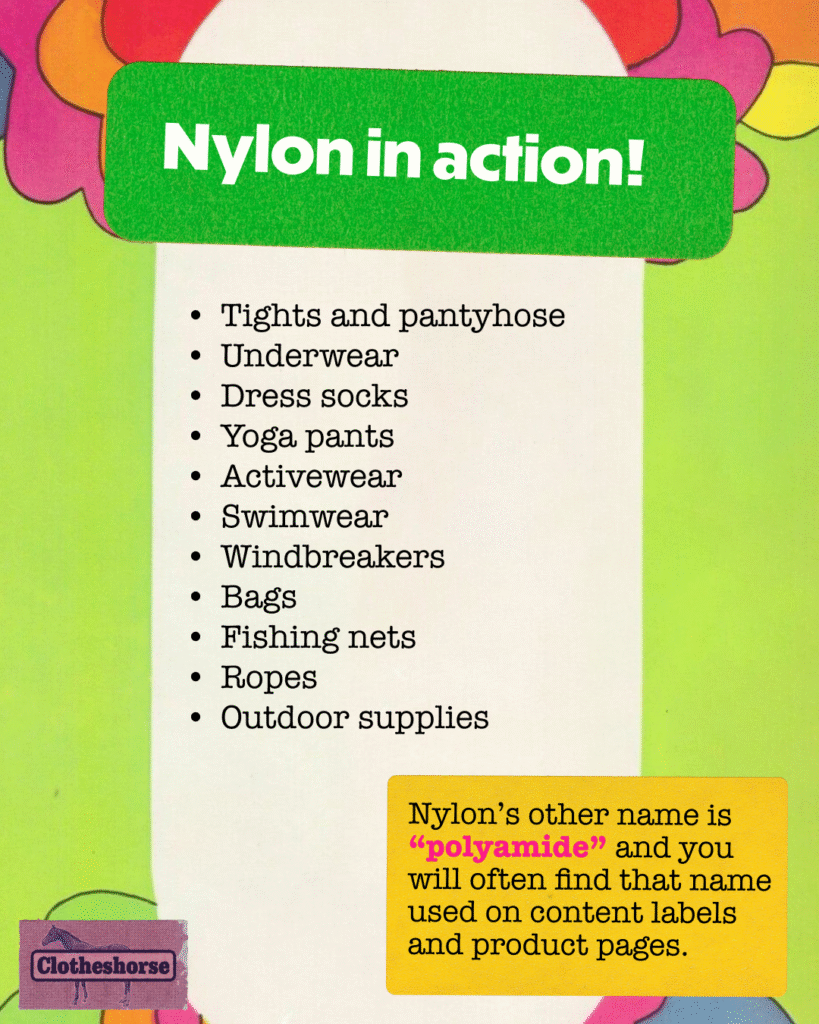
Nylon isn’t just limited to tights (as you’ll learn in these slides), it’s also a component in a lot of things we can buy and wear, including UNDERWEAR! Retailers tend to label underwear made of nylon as “polyamide,” which is just a confusing, mysterious sounding term that means NYLON. Who’s using polyamide/polyamide blends to make underwear? The list is long, but it includes Skims, Cuup, Knix, and (I’m pretty sure) Parade <—that one’s a guess because they don’t ever truly say what fibers they are using unless it’s a greenwashing opportunity. 🤔
If you’re looking for natural fibers/ethical underwear, I recommend searching “underwear” on Good on You!
During WWII, scientists were searching for an alternative to silk and hemp for parachutes. Nylon was a great solution. In addition to being used for parachutes, ropes, etc, it was also an affordable/plentiful substitute for silk.
At the beginning of the war, 80% of textiles in the U.S. were cotton, with wool making up the rest. But by 1945, synthetic fibers comprised 25% of U.S. textiles.
After the war ended, manufacturers worked hard to make synthetic fabrics even more prevalent and lucrative. Fabrics like silk were in short supply and people were making clothes out of nylon parachutes. The idea of making women’s clothing out of nylon picked up steam.
Nylon was significantly less expensive than natural fibers, so it was marketed a as a low cost, “wonder fabric.”
DuPont originally planned to market nylon as “no-run.” But unfortunately anyone who has ever worn a pair of pantyhose will tell you…NYLON RUNS!
Customers weren’t loving nylon because it was prone to easy damage and it was very unbreathable.
In fact, nylon would have faded away into the sunset if scientists hadn’t discovered that it blended well with polyester, spandex, and cotton…and it became a lot more durable!
A monomer named diamine acid is extracted from crude oil.
The diamine acid is forced into a chemical reaction with adipic acid that creates a polymer called nylon salt.
The crystals are heated to form a molten substance.
It is extracted through a spinneret, stretched, drawn, and then finished. Cooling the fibers requires a large amount of water.
At this point it is almost always blended with another fiber before being knit/woven into fabric.
Nylon relies on fossil fuels as a key ingredient and its production uses a great deal of energy.
The production of adipic acid (necessary for the creation of nylon salt) releases nitrous oxide (a greenhouse gas 300X worse for climate change than CO2).
Nylon is not biodegradable so it lives in the landfill indefinitely. It is sometimes recycled (but not widely). However, blended fibers are difficult (if not impossible) to recycle.
Nylon releases microplastics when washed.
Before you gather your tights and swimsuits into a pile and start weeping over them, remember all of the things we talk about around here:
Make your tights, swimwear, and yoga pants last by caring for them.
Handwash and air dry them. Check out the other laundry advice in part one of this series.
Buy what you love and plan to wear often. Don’t impulse shop swimwear and leggings.
If you can afford it, there are brands that use recycled nylon to make tights and swimwear. However, remember that like many plastics, nylon can only be recycled once, so don’t overconsume.
Anything containing nylon that you purchase (or already own) will be on this planet for centuries. Shopping with this in mind really, well…changes the shopping experience, right?
When you no longer wear something, rather than tossing it in the trash or donation bin, mindfully rehome it via friends/family, your local Buy Nothing Group, or host a clothing swap party.
Graphics from this post are from the 1972 Rock Flowers paper dolls book.
If you want to share your opinion/additional thoughts on the subjects we cover in each episode, feel free to email, whether it’s a typed out message or an audio recording: amanda@clotheshorse.world
Deco Denim is a startup based out of San Francisco, selling clothing and accessories that are sustainable, gender fluid, size inclusive and high quality–made to last for years to come. Deco Denim is trying to change the way you think about buying clothes. Founder Sarah Mattes wants to empower people to ask important questions like, “Where was this made? Was this garment made ethically? Is this fabric made of plastic? Can this garment be upcycled and if not, can it be recycled?” Signup at decodenim.com to receive $20 off your first purchase. They promise not to spam you and send out no more than 3 emails a month, with 2 of them surrounding education or a personal note from the Founder. Find them on Instagram as @deco.denim.
Selina Sanders, a social impact brand that specializes in up-cycled clothing, using only reclaimed, vintage or thrifted materials: from tea towels, linens, blankets and quilts. Sustainably crafted in Los Angeles, each piece is designed to last in one’s closet for generations to come. Maximum Style; Minimal Carbon Footprint.
Republica Unicornia Yarns: Hand-Dyed Yarn and notions for the color-obsessed. Made with love and some swearing in fabulous Atlanta, Georgia by Head Yarn Wench Kathleen. Get ready for rainbows with a side of Giving A Damn! Republica Unicornia is all about making your own magic using small-batch, responsibly sourced, hand-dyed yarns and thoughtfully made notions. Slow fashion all the way down and discover the joy of creating your very own beautiful hand knit, crocheted, or woven pieces. Find us on Instagram @republica_unicornia_yarns and at www.republicaunicornia.com.
Cute Little Ruin is an online shop dedicated to providing quality vintage and secondhand clothing, vinyl, and home items in a wide range of styles and price points. If it’s ethical and legal, we try to find a new home for it! Vintage style with progressive values. Find us on Instagram at @CuteLittleRuin.