In a world of greenwashing, wall-to-wall podcast ads, and affiliate marketing “listicles,” it’s really hard to know if a brand is actually as sustainable and ethical as it claims. Well, Amanda has been looking into this kind of stuff for years, so in this episode they will show you exactly what they do when they want to figure out the true story of a brand. And specifically, we will unpack Quince as an example!
In this episode:
Helpful links and reading:
@sustainablefashionfriend
@alookbehindtheseams
Good On You
Eco-Stylist
Cobbled Goods
“Not everyone is loving Quince’s dupes,” Chantal Fernandez, The Cut.
“Williams-Sonoma sues Quince over sales of ‘dupe’ products,” Jonathan Stempel, Reuters.
“Beyond Compare? Quince Battles Class Action Over Its ‘Traditional Retail’ Pricing Model,” ArentFoxSchiff
“I got a cease and desist from Quince,” Ecocult.
Amanda’s first post about the Esprit sweatshirt (you can also find this on IG)
“About that viral Esprit sweatshirt…the revolution will not be for sale at Costco.” (you an also find this on IG)
The new Clotheshorse PO Box: 69 Main Street, Box 16 New Providence, PA 17560
Get your Clotheshorse merch here: https://clotheshorsepodcast.com/shop/
Until the end of July, use promo code THEPRICEISRIGHT to get 50% off all merch! Amanda and Dustin care for a colony of 12 feral cats and they want to get them all fixed this spring. So help them cover that cost by picking up some hot deals on Clotheshorse merch.
If you want to share your opinion/additional thoughts on the subjects we cover in each episode, feel free to email, whether it’s a typed out message or an audio recording: amanda@clotheshorse.world
Did you enjoy this episode? Consider “buying me a coffee” via Ko-fi: ko-fi.com/clotheshorse
Welcome to Clotheshorse, the podcast that has been around for six years!
I’m your host, Amanda and this is episode 262.
And in this very special episode, I am going to show you, yes, YOU, how to background check a brand. What does it mean to background check a brand? Well, don’t you worry…I’m going to get into that in this episode!
Before we jump into that, here’s a little update on Operation Snip Snip:
Six years ago, the first episode of Clotheshorse was released! It was recorded approximately two feet from my bed on a very hot day in Philadelphia. One very unglamorous thing about having an independent podcast? You can’t record anywhere near an air conditioner or a fan because it messes up the audio. So any time you listen to an episode that was released during the summer, know that I was sweating my ass off while I worked on it. Literally! Having a podcast has helped me discover just how much sweat my butt can generate.
But that’s not all I have learned along the way! From the technical stuff (Photoshop, editing audio) to the emotional stuff (setting boundaries, stopping my people pleasing habit) to actual hard knowledge about government regulations, private equity, clothing manufacturing, and more. Seriously I don’t know how my brain made space for everything I have learned!
It’s had its ups and downs along the way. The downs include death threats from vegans. Stalkers harassing me, my family, and my friends. A whole traumatic experience with Remake. But the ups have faaaaaaarrrrrrrrr outweighed any of the bad stuff: The Clotheshorse Jamboree. The live shows last fall. And most importantly, all of the amazing friends and collaborators I have met over the last six years, thanks to our shared passion for a better world!
I am so proud of the work I have done so far. It hasn’t always been perfect because I have been learning alongside all of you, but both my heart and mind have grown exponentially over the past six years.
One thing you have probably noticed is that there have been less new episodes of the podcast this year. For about 5 of the last 6 years, I have been balancing working a full time job (to pay my bills) with Clotheshorse (an unpaid full time job). And for a long time I made it work: I worked six days a week, usually 10-12 hours per day. I only took Saturday off (but I usually ended up working a few hours anyway). I didn’t socialize or binge watch Netflix or really do anything other than work. Someone I was able to keep doing that for a long time without feeling burned out or exhausted. But this year, I knew something had to change. Life was passing by me so fast…and all I had to show for it was a lot of podcast episodes? It just didn’t feel good. And specifically this year, I picked up a lot more clients and with all of the TNR, the foster kittens, the everything else going around me…I started to dread getting out of bed every day because it just meant nonstop work until I got to go to sleep again.
So I’m giving myself some more space this year to move a little bit more slowly (just a little bit). I’m targeting two episodes a month…which when you consider that most episodes are two hours long, it’s kinda like you are getting four any way. It gives me time to read for fun (not just for Clotheshorse). Work in my garden. Stare into space. Whatever I need.
I need to slow things down or I’m going to end up quitting, to be honest. I don’t want that to happen. I just can feel the burn out right now. The only days I haven’t worked this year were when I had norovirus, which is so depressing to say out loud. So expect less episodes until something changes in my life, but know that I’m just as committed to creating high quality, thoughtful work.
So yeah, one thing I am working as “Clotheshorse” is my people pleasing habit. And TBH a lot of the time it is the “strangers on the internet pleasing” that is wearing me down. Like, a few years ago, a follower on Instagram asked me if there was another place I could share my content. They were trying to stay off of social media, but still wanted to see my stuff. So what did I do? I created a google folder for this person and I uploaded every post for a few months. And of course, I shared this folder with them. Along the way, I had to pay extra money to increase my google drive storage because some of the posts were videos, so they were taking up a lot of space. Fine, fine. Months later–still dutifully putting every single post in this damn folder–I looked up the folder history and realized that the person who had requested it…had never looked at it even once.
That was actually the moment that I was like “okay, I need to stop trying to please everyone and start drawing some boundaries.” I always joke that when a person starts a business, their customer service policy is one sentence. But a year later, it’s a scroll of paper so long that it rolls down the stairs and out the door. Basically, new boundaries and rules are built as things go awry. And I’ve certainly learned how to set boundaries/stop being a people pleaser by experiencing all kinds of misadventure and trauma as Clotheshorse. And sometimes it’s just exhaustion that makes me learn the lesson.
A year or two ago, I stopped answering DMs on Instagram. It’s not because I didn’t like talking to people. But I was experiencing this issue over and over again: I felt like I was running out of time every single day, but I wasn’t getting everything done that needed to be done. Like, I would start working at 8 am and by 8pm I felt like I needed three more hours to finish my list for the day.
So I did something that I always recommend to my clients: I spent a week keeping track of how I spent my time every day, whether it was meetings, responding to emails, making lunch, or spending time on social media. And at the end of that week, I learned the horrifying truth: I was spending 3 hours a day answering and responding to comments and DMs on Instagram.
THREE HOURS. 21 hours a week!
And that probably seems wild, but think about it. If 20 people DM me in one day and I spend 5 minutes chatting with each person…well right there that’s 100 minutes, more than an hour and a half. And often I was actually receiving 40 or 50 messages in a day. And some of those messages were emotionally difficult: complaints about thrift stores/resellers, epic stories of trauma, unwelcome advice, weird and completely inappropriate feedback about my appearance, sometimes people just being straight up trolls. And lots of messages asking me “is _____ brand sustainable? Why or why not?”
So I stopped responding to DMs…and omg what a life changer to get those hours back every day. But I felt terrible. I had to have a sort of “come to Jesus” with myself about it. Basically, “Hey, Amanda, you are a person who needs to work, sleep, eat, relax, do laundry, spend time with other humans, clean the house, run errands, and so on. Stop trying to make everyone else happy at your own expense.”
But the messages like this still find their way to my inbox:
“Is Quince a good brand?”
“Is Reformation fast fashion?”
“Where am I supposed to buy clothes?”
With two full time jobs, feral cats to TNR, and a desire to have some work/life balance, I just don’t have time to do the work of background checking brands for others.
But you know what I can do? Is show you HOW to do it yourself!!! I am not a super genius about figuring out what’s going on with a brand. I just know how to search for information. Maybe it’s all that time I spent hanging out at the library when I was a kid. Maybe it’s all the mystery novels I read as a bored tween. Maybe it’s just that I love learning new stuff. And seeing through greenwashing and other marketing scams makes me feel so powerful!
In this episode, I will show you exactly what I do when I want to figure out the true story about a brand. And specifically in this episode, we will dig into Quince as an example. So all of you who are wondering about Quince will get your answers!
The last thing I want to say before we jump into the episode is this: I get a lot of requests to do “take down” posts and episodes on brands. I am not going to do that.
For one, it’s just not that interesting to me because it’s almost the same story over and over again. It also has this super negative undercurrent that feels unnecessary in scary times. I want to be a source of education, inspiration, and hope. And lastly, it puts me in legal peril that I just do not need as a person who does this work for free and does not have extra money to pay lawyers. Quince (for example) specifically has spent a lot of money over the past few years sending scary letters to activists and journalists in the sustainable fashion space. I don’t need that.
And also: there are people out there already doing this work. If you’re looking for deep dives into specific brands, including their quality and supply chains, I can recommend two instagram accounts that do a great job of this: Sustainablefashionfriend and alookbehindtheseams. I will link to both of them in the show notes so you can check them out and give them a follow! As I walk you through my methodology for “background checking” brands I’ll be calling out some other resources, too.
In the previous episode of the podcast, we talked about SHEIN’s purchase of Everlane. And as I discussed then, a lot of people felt very betrayed, angry, and confused about the announcement. If Everlane was as radically transparent and sustainable as it had been claiming for years, why were they selling to SHEIN?
And the overarching question was, “Had Everlane been misleading us all along?”
Well, as I talked about at length in the previous episode, a detailed report by The New York Times in 2020 revealed what Everlane really was. And activists, organizations, and journalists have been talking about Everlane’s greenwashing and toxic internal culture for years.
Any customer wanting to “background check” Everlane’s claims could have found clear answers in less than a minute with a simple internet search.
So why weren’t people doing that?
For one, emotional branding is a hell of a drug. It drowns out anything bad we might hear AND it prevents us from looking for any information.
Secondly, Everlane was engaged in a lot of what Greenpeace calls “ad bluster,” heavily marketing the few “sustainable” (always in heavy air quotes) and “ethical” (yes, also in air quotes) things it was doing. Beyond digital marketing like social media ads, affiliate marketing, and emails, the company was also capturing a lot of great PR for a long time with a steady stream of glowing writeups that pollinated the internet with good vibes for Everlane…despite that extremely damning NYT report.
But lastly, people just want to shop. They don’t want shopping to start with a whole research project. And I get it.
It IS super unfair that brands can mislead us…and it’s somehow (mostly) legal.
We shouldn’t have to do extra work to buy something, but that’s how it is. And personally, I would rather spend a few minutes tracking down the true story about a brand or product than risk giving money to liars and assholes!
I read reviews for products and services before making a decision about what to buy. And doing this has saved me from buying the wrong moisturizer or eating at a restaurant without vegetarian options. I would never buy an article of clothing without referencing the brand’s size chart. Fact checking a brand’s claims or learning more about its values just feels like another form of reading reviews and checking size charts. It all helps me make the best decision and avoid disappointment.
But also, it’s part of the slow fashion way of life!
Knowledge is the fuel for change. Knowing the facts allows us to make the best choices for the future we want for ourselves and the planet.
Finding information on your own about the ethics and true “sustainability” of a brand is an important part of being an educated and concerned citizen!
And when you know the facts about a brand, you can share that information with other people, too.
Also: doesn’t it kinda piss you off that brands and corporations can mislead us and get away with selling us shitty stuff? Shitty stuff made via human suffering? And then they get to take our money and do terrible things with it?
Yeah, no. TBH the vindictive, grudge holding part of me is HIGHLY motivated to background check brands.
So choose your reason: protecting yourself, protecting the planet, or just raging against the machine. No matter what is motivating you, getting to the bottom of a brand’s REAL situation is easy, you can do it with your phone, it only takes a few minutes, and you only have to do it once.
Over the past year or so, my DMs and email inbox have been FILLED with questions about Quince. And I’m not surprised, because I encounter Quince ads everywhere: on Instagram, TikTok, and on just about any “big” podcast.
Now the concept of Quince is nothing new from an emotional branding/marketing perspective: Quince purports to sell high quality products–from clothing to home goods to caviar– at significantly lower prices than other brands. Cue the claims of “cutting out the middleman” and “affordable luxury.”
So yeah, nothing new per se. It’s what TJ Maxx and other off price chains have been doing for decades. It’s essentially what Everlane was claiming, too.
Right out of the gate there are a few red flags for me (before I even begin the official “background checking” of it all):
Thousands upon thousands of items. A product catalog so deep, so wide, that there’s no way the brand could have a clear grasp of the working conditions within its supply chain. If we dig back into the classic Clotheshorse archives, we’ll find the “is it fast fashion checklist?” And right out of the gate, Quince is checking a lot of boxes.
Okay, so lots of red flags right away.
Now the next red flag is one that you might not notice right away, especially if you’re not involved in fashion or fashion marketing, or just business marketing as a whole. And that’s the nonstop flood of advertising, affiliate marketing, and influencer partnerships across every single platform and just about every form of media.
That costs so much money.
Money that actual sustainable, ethical brands don’t actually have.
Money that actual sustainable, ethical brands never get to access. Why? Because bluntly, no one becomes a billionaire from sustainable, ethical business. I mean, when you think about it, there is no such thing as an “ethical billionaire.” It’s an oxymoron.
I know that sounds like hyperbole, so let’s get down to some retail math.
Making high quality anything, and making it ethically (meaning everyone works in safe conditions and gets paid a living wage) costs more money. Period. And in most cases, consumers feel priced out. So often sustainable, ethical businesses have a lower profit margin, meaning, they don’t markup the stuff they are selling as much as traditional retailers do. Fast fashion specifically tends to chase a high 70s/80s markup. Meaning that they are marking up an item 4-5 times the cost of actually making that item. So if it costs $5 to make, they are selling it for $25. Sustainable, ethical businesses can’t do that because the prices would be too high for customers, so they are marking up their stuff 2-3x the cost to make it. And remember, that markup has to pay for staff, rent, utilities, etc. That doesn’t mean that the business can’t thrive, grow, create more jobs, etc. I work with clients who are doing that. But it is a slower process.
And surprise, surprise: investors aren’t looking for slow growth. They want fast growth, immediate return on investment. So that means high profit margins, that 4-5 times markup instead of 2-3x.
That brings me back to the wall-to-wall advertising carpet that Quince has been buying. That costs SO MUCH money. None of my clients could even afford a fraction of that. When I see that level of advertising, I know that the company has received a TON of investment. And whoa Nellie, Quince sure has received a lot of money:
To be clear, Quince would not be receiving that kind of investment if it weren’t promising fast growth and profitability to its investors. And sorry, but fast growth is just not ever going to be sustainable and ethical.
So just to recap where we are so far: before I even started doing a standard background check of Quince, I had a lot of misgivings about it, specifically the massive product assortment, the too-low-to-be-true product pricing, and the nonstop advertising across the internet.
But two more things gave me a bad feeling about Quince:
Okay, so all that to say…I’m coming into this Quince “background check” exercise knowing that Quince is probably not a brand I would ever give money.
But let’s pretend that I (and now, you) don’t know any of that. Let’s begin this background check, okay?
Step one is to search for a brand using a site that rates brands based on their supply chains, materials, and animal policies. I recommend Good on You (goodonyou.eco is the URL) because it is the most comprehensive and easy to understand. It rates based on People, Planet, and Animals, using a wide variety of data and a trusted methodology.
FYI, if you can’t find a brand on Good on You, it might be too small or new. We will come back to that problem later, so put a pin in it.
Now is a good time to give you a little bit of a disclaimer on Good on You: sometimes their ratings are a little too falsely positive or out of date. Or they will hype a brand like Reformation that is 100% fast fashion.
I have a lot of theories about that but it comes down to money. Running a free platform like Good on You still costs money: money to maintain the site, money to do the research and evaluations, money to create the content, etc. And I suspect that just like everyone else in the sustainability space, Good on You is not getting a lot of funding these days. TBH most people and organizations doing the educational part of sustainable fashion were never really making bank, but until 2024-ish, there was some money…mostly coming from brands like All Birds, Adidas, and H+M. But when they stopped seeing sustainability as a lucrative marketing story, they stopped funding slow fashion organizations and events. Just about every other brand followed. And the truly sustainable, ethical business out there? They don’t have the resources to fund that work, either.
Some organizations closed up shop (like Remake). Content creators, writers, and activists got other jobs or pivoted into other areas.
So how does Good on You keep the doors open? Affiliate links and sponsored content. Meaning: they get paid to write about brands. If you buy an item recommended in a post or email, they get a cut of the sale.
The thing about taking money from brands…is that it gets hard to be critical of brands. So you might be a little softer about them or talk about them a lot less.
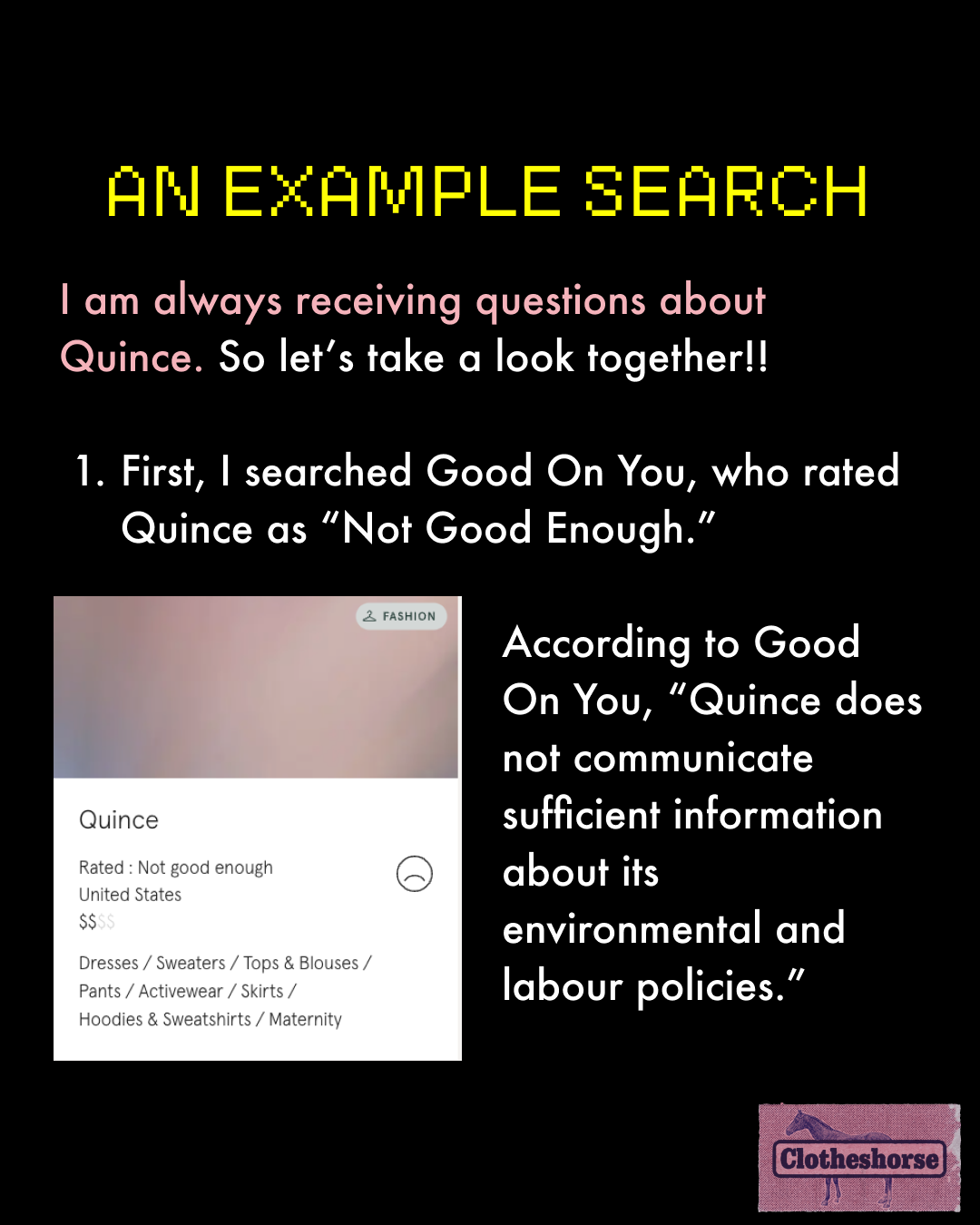
That said: Quince does NOT have a good rating on Good on You. In fact, its rating is “Not Good Enough.”
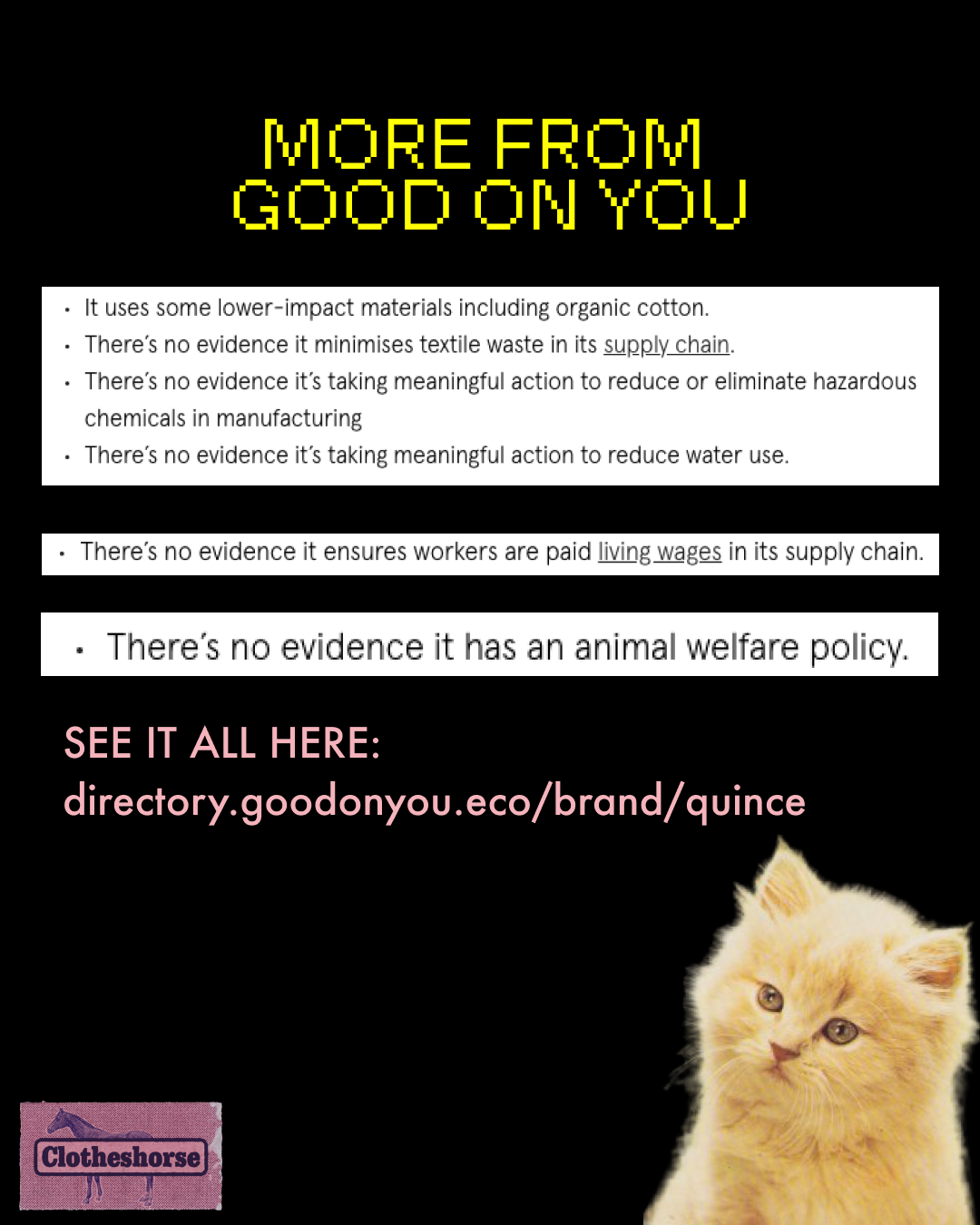
According to Good On You, “Quince does not communicate sufficient information about its environmental and labour policies.”
One app/platform that comes up a lot in “sustainability background check” conversations is Commons, which is an app and website that allows you to evaluate brands and make direct purchases. Commons makes its money via affiliate sales, meaning when you buy something after being referred by Commons, they get a cut of the sales.
To be honest, I think Commons is “fine” but I have a few ethical misgivings about the company. First off, despite raising $13.9 million in investment, the app still frequently steals and reposts other people’s work without permission (myself included), rather than truly collaborating with writers, activists, and content creators in the sustainability space. Or gasp…actually funding some of their work. Like alleged “sustainable” brand Quince sending a cease and desist to a sustainability writer, this feels icky to me.
But also, Commons has investors that really turn me off, including Sequoia Capital, which has also invested in companies with major ethical issues like SpaceX, Airbnb, Doordash and Instacart, along with lots of generative AI companies like Anthropic.
So I feel kinda iffy on Commons, but it’s still an easy tool that you could use (but they also give Reformation a very high rating, so take it all with a grain of salt).
I’m also just going to remind you of two other past Clotheshorse guests who have done a lot of work to background check brands for you:
But back to Quince: based on Good on You’s rating, that would be enough to be like “okay, this is probably not a place I want to shop unless they are literally the only place that has what I need at a price that I can afford.” And then I would make the purchase and make sure whatever I bought lasted as long as possible by laundering it carefully and mending it when necessary. And I would wear it as much as possible.
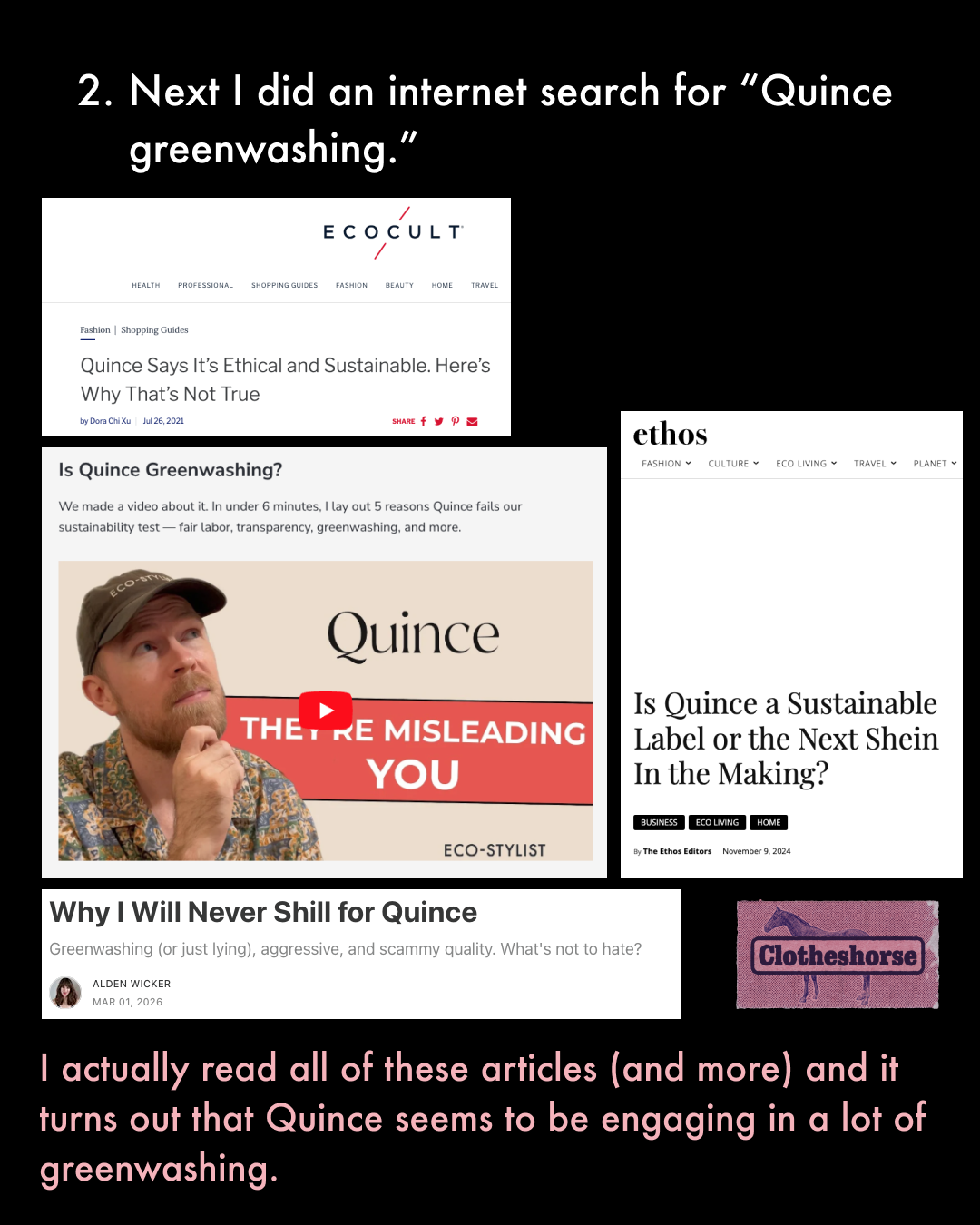
Let’s just say that maybe the Good on You rating wasn’t clear enough, maybe it was kinda middle of the road, or maybe it didn’t even exist. That’s when I would open up a search window and type in “Quince (or whatever brand I’m searching)” and “greenwashing.”
Now, if I was using google, I would ignore the AI search results, which tend to be inaccurate or fully just wrong. In fact, analysis published this spring indicated that about 15% of the AI overview results from Google were incorrect. That probably doesn’t sound too bad, right. That means 85% of results are good. That sounds decent. Except google processes more than 5 trillion searches every year…so 750 billion of the AI overviews would be wrong. And that’s a lot of wrong answers. Ask me about the time the AI overview said that Clotheshorse was hosted by someone named Andrea Kennedy.
One of the reasons these AI overviews can be inaccurate is that they are pulling data from all over the internet, including glowing affiliate link “listicles” and Reddit posts that could have been been written by anyone.
Want to avoid AI altogether in your searches? Well first off, don’t ask ChatGPT and Claude. WHY ARE YOU DOING THAT? Instead use Duck Duck Go and turn off the AI options.
So doing an internet search of “quince greenwashing” pulls up SO MANY results, and none of them look good for Quince.
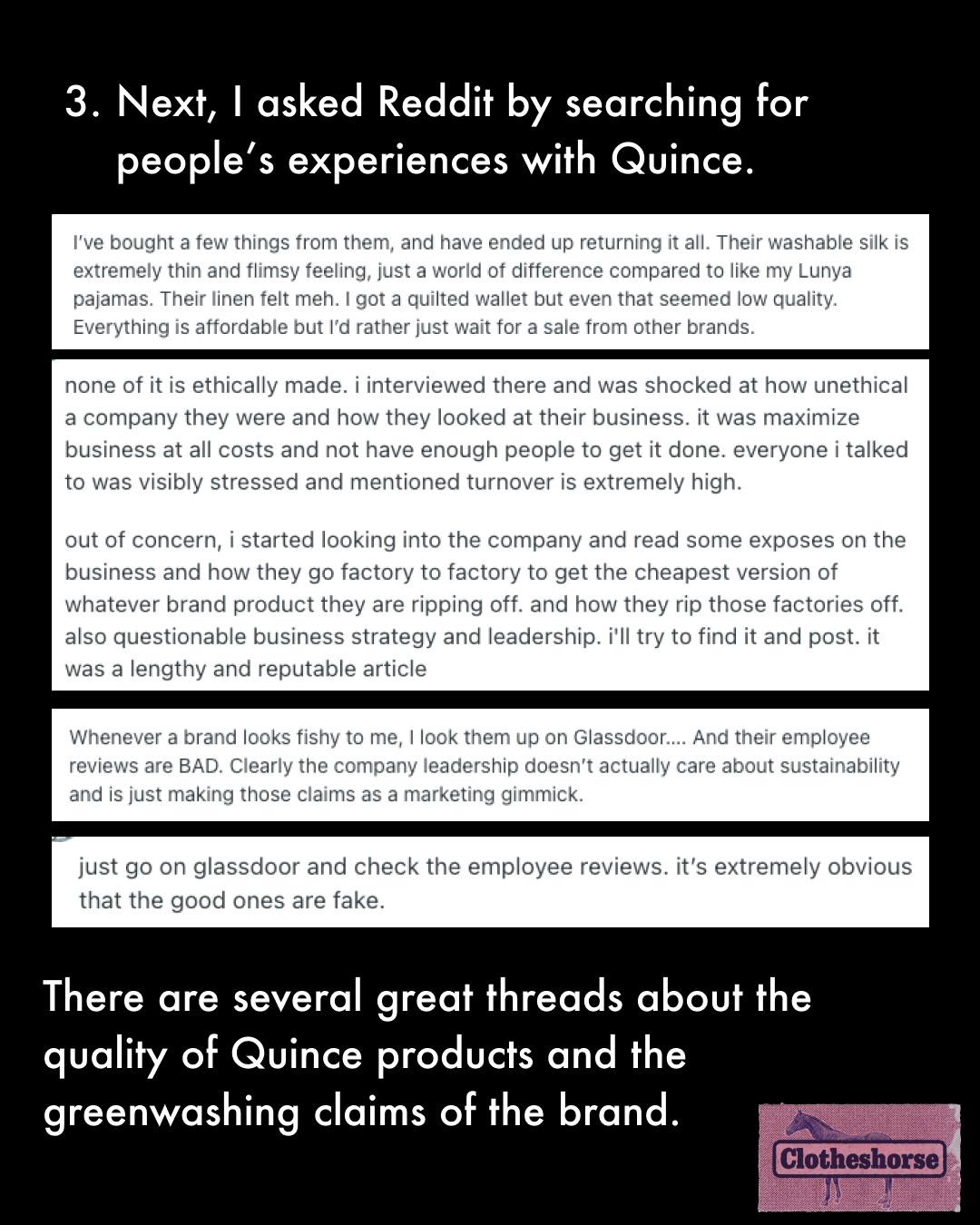
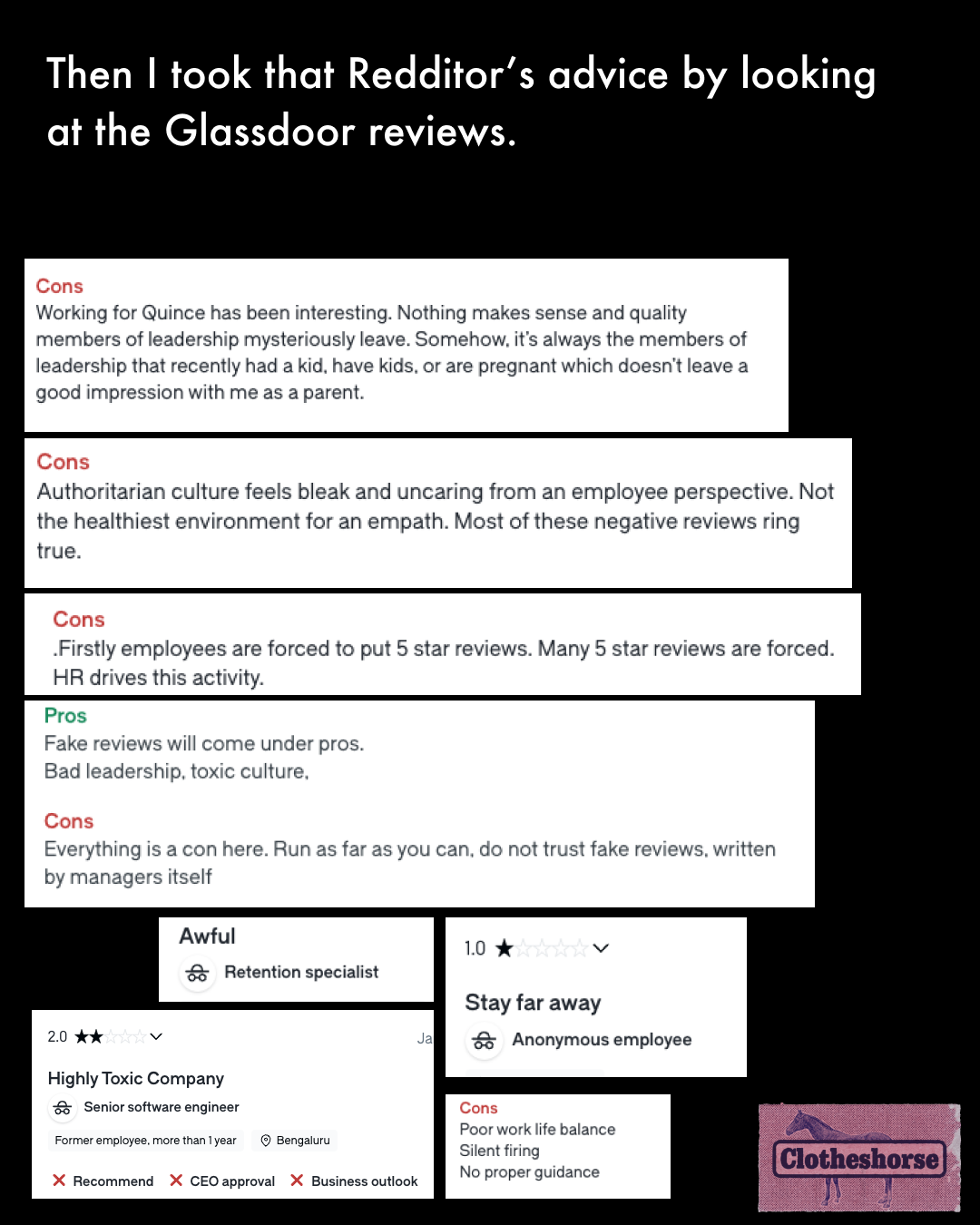
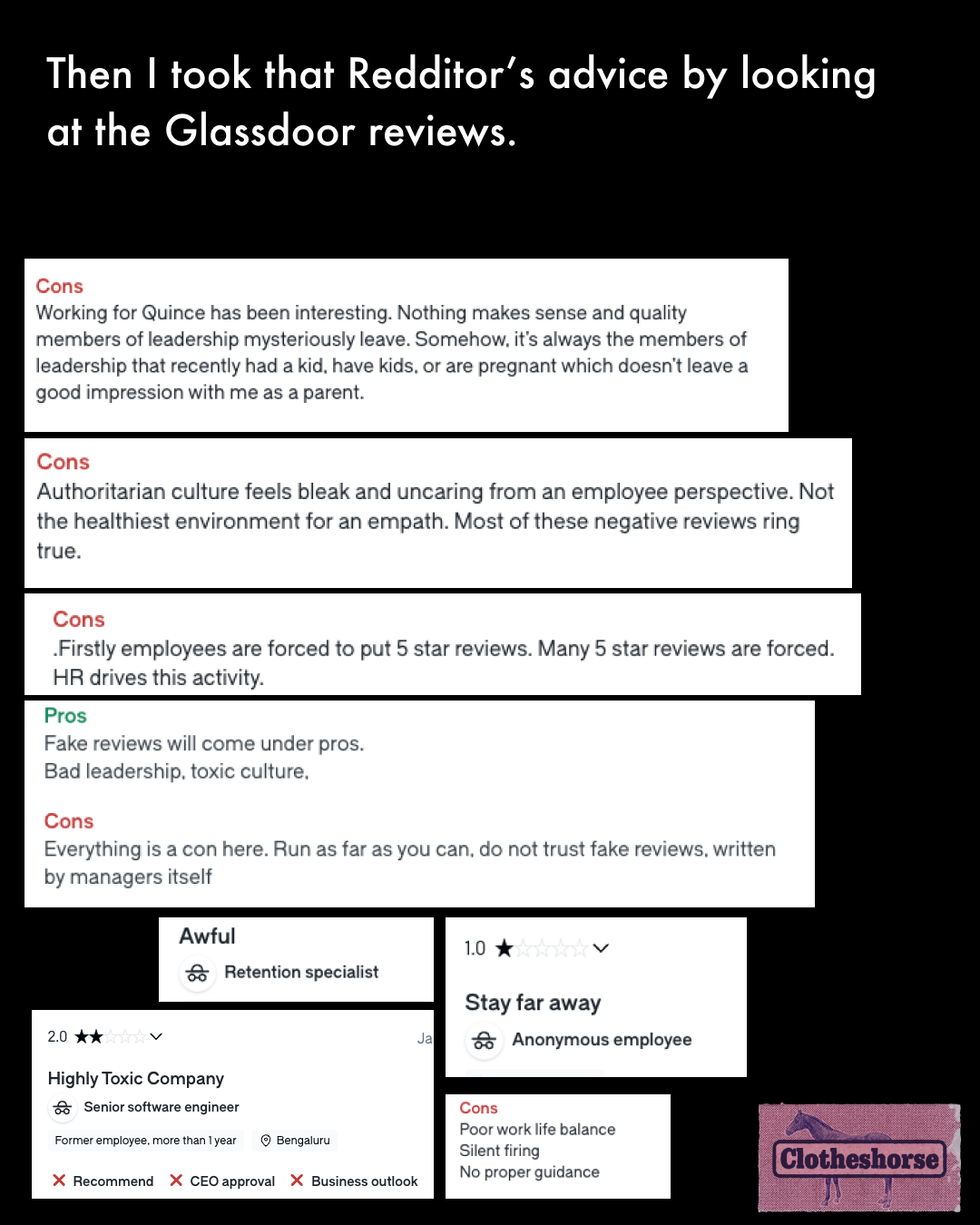
Okay, so let’s talk about Glassdoor. Glassdoor is a website where employees (past and present) can anonymously review their experiences working for a company. And my experience has always been that if you want to know how ethical and sustainable a brand is, talk to people that work there. Seriously, that’s why I know that Reformation is not what it says. When I worked at the horrible “feminist” brand, we actually got together to write reviews all at once because we didn’t want more people to find out what the brand was really like the hard way by working there.
Now one common “sign” that a company culture is toxic is that you will see a sprinkling of clearly fake reviews (posted either by HR or some other employee forced to do it) that are so super positive: five stars, no negative feedback at all, and recurring statements like “fast pace isn’t for everyone.” And let me tell you, Quince’s Glassdoor review has all of the hallmarks of a bad place to work, including the fake positive reviews.
Now, sometimes a company is terrible and it doesn’t have any reviews. That’s often because the team is so small that it would be obvious who left the review. And/or the company is a scary place to work and people are afraid of retaliation. Both of these were the case at the feminist brand. So absence of reviews/bad reviews doesn’t mean a company is good, but bad reviews mean, well, proceed with caution.
In this case, Quince sounds like a terrible place to work. And with allllllll of my years of experience of working in toxic fast fashion work environments, I know that a horrible corporate culture means that no workers are being treated well throughout the supply chain. Like, if you can’t take care of your corporate staff who are literally right there, you definitely do not care about your garment workers, warehouse workers, etc. And also: if you don’t care about your employees, you probably don’t really care about “sustainability” either. It just demonstrates a lack of care and concern for humans.
After everything I learned from this search (which only took about 10 minutes), I would definitely not purchase something from Quince.
But most importantly: now I know about this brand and I can tell my friends about it. That feels like a superpower! And, I have learned a little bit more about the tricks brands pull to confuse us into thinking they are sustainable and ethical. I will spot them more easily in the future!
Okay, but what if you can’t find the answers?
This happens sometimes, especially if a brand is still small or new. In this case, I do two things:
But also, TRUST YOUR GUT! If you’ve listened to enough Clotheshorse, you know when something just doesn’t add up!
Sometimes you just kinda know that something is too good to be true. As I explained earlier in this episode, I had suspicions about Quince for a while because many of the thrift stores in my area are flooded with unsold, brand new Quince inventory. That’s a red flag that a company is overproducing and then dumping it on thrift stores.
Another red flag for me was the sheer volume and variety of stuff Quince sells…clothes, home goods, personal care products, and…caviar?! Yeah, that looks a little bit too much like Temu or SHEIN to be truly sustainable. No company can make and sell all of these different kinds of things while still maintaining a transparent, ethical supply chain.
“Well, there’s no ethical consumption under capitalism, so why does this even matter?”
NOPE. Sorry. I do not accept that response/excuse/coping mechanism.
And actually, there are TONS of brands all over the world that are working really hard to do things the right way. You just don’t know about them because they don’t have mega marketing budgets like Quince! Good On You, Eco-Stylist, and even social media are great ways to find them.
Furthermore…we can EASILY make more ethical decisions by
But what if after all of this, you still feel as if shopping from Quince (or whatever other brand you were looking at) is the best option for you because of price, size, or accessibility?
Ultimately, I think a lot of people want me or someone to give them permission. To buy a certain thing, to shop from a specific brand, et cetera. And the first thing I’m going to tell you, is that you don’t need anybody’s permission…but your own. So where you shop, what you buy? That’s all on you. It’s your choice. You can make those decisions, and you can trust yourself to make those decisions, based on what matters to you.
Now, something that I say a lot is that we can’t shop our way to a better world. I’ve been saying this for six years. And sometimes on social media a small business will show up and be like, “well, actually, I think you could shop your way to a better world by buying stuff from me and other small businesses.”
Yes, shopping small, shopping local, diverting your money away as much as possible from businesses and companies that don’t share your values, sort of divesting your paycheck from mega corporations. Yes, those are significant political acts. And they are part of building a better world. And I will tell you this: I have serious issues with political groups and content creators who are shilling fast fashion merch, printed on demand merch, or even just using their platform to encourage people to buy that low quality, fast fashion viral Esprit sweatshirt from Costco. Because where we shop is political. What we buy is political. And while I don’t think human rights and protecting our planet should be a political issue, THEY ARE If you’re out there building a platform or organization off of progressive values, why are you encouraging fast fashion consumption?
Because as sad as it is, we have inadvertently (for generations) shopped our way to a worse world. Landfills and oceans full of plastic clothing, plastic packaging, plastic toys and plastic Halloween costumes. Generations of humans doing this. But the solution is not shopping our way out of it.
For too long, where we shop, what we buy, how we shop, has been treated as a reflection of who we are as people, right? Like the most important thing about us is what we wear and the brands we wear and where we bought it and how much money we spent. And that’s really why emotional branding is so powerful. Since we were small children, it’s been ingrained in us that what we buy and where we buy it, is representative of, is a reflection of who we are as humans.
And because this has both literally and subliminally been repeated to us over and over again, it becomes too easy to say, “oh, if I just shop from sustainable brands, if I just shop small and local, I’m a good person. I’ve done my good deeds, and everything is fixed.”
And that is just not true. Because as I say all the time, slow fashion is a way of life. It’s not JUST what you do or do not buy. Sure, that matters a lot. Billionaires exist because they often have generational wealth and other opportunities that the vast majority of us will never have. But they also exist because we give them our money. We need to stop doing that like, YESTERDAY.
But slow fashion is also reducing your food waste, and using less plastic and being a part of your community and voting and being really active in so many different ways in making the world a better place. Of living your values every single day. It’s doing the very hard personal work to rebuild your relationship with shopping and stuff. Understanding why you feel driven to buy things you don’t really need. How it makes you feel before and after. Breaking the habit of impulse shopping or so-called “retail therapy.”
Shopping small shopping local? Yes, that’s like one star in a large constellation of save the world, change the world, build a better world behaviors. And we have to do them all.
And so when I say we can’t shop our way to a better world, what I’m saying is, shopping alone is not the cure. If we’re making smart choices about how much we buy and when we buy it, and we’re making that stuff last for a really, really long time. We’re mending it and repairing it or mindfully rehoming it…all of those things…we’re actually disrupting the status quo of overconsumption and fast fashion and fast everything. So if Quince is your only option or the best option for you, fine. But…do all of the other slow fashion things, too. Don’t give up.
No one gets to skip the “buy less new stuff” of slow fashion.
But change is hard. And that’s why greenwashing and this whole conceit that we could shop our way to a better world is so appealing because it’s sort of like, oh, you don’t have to change anything else about yourself. Just buy stuff from here instead of there. And you’re good. And that’s just not true. But like 90% of the posts on the sustainable fashion subreddit are “where can I find a sustainable version of this highly trendy piece that I only plan on wearing one time for Coachella.” Ugh…you’re so close. What you really need to do is stop buying hyper trendy things that you plan on wearing one time for Coachella!
Now, “buy less new stuff” is another one that people show up periodically to fight with me about. It used to be surprising. I mean, we’re like-minded people. We’re fighting for the same thing. But they want to tell me “actually, you CAN overconsume stuff if you’re buying it from the right person.” That’s just not true either.
Please, please take a step back and think about it. There’s someone who owns a wool farm who sent me a series of emails. I doubt they’re listening to this episode because there’s no way they’ve ever listened to an episode of this podcast or they wouldn’t have dared send me the emails that they were sending me. They were basically telling me that, yes, people could overconsume wool as much as they wanted, and there would be no negative impact on the planet. And the problem with me saying that people shouldn’t overconsume stuff is that I don’t understand how farming works. I don’t understand agriculture, et cetera. They were incredibly patronizing. And I was like, “ma’am. If everybody was buying wool clothing at the rate they’re buying polyester clothing right now, we would see all kinds of new problems develop.”
One would be that, of course, producing wool at that scale would mean that there would be all kinds of animal mistreatment across the world. That’s already happening right now, by the way. PETA sent me a video of sheep being abused at a wool farm, I’m still traumatized by it. Imagine, we’re already seeing humans being exploited and mistreated to make clothing. Let’s just throw some sheep into that. But also, the industry would need to make room for all those sheep to graze, so we can keep just cycling through clothes all the time. Of course, we would lose a lot of land that’s currently being used for other forms of agriculture, like, I don’t know, growing food or, you know, enjoying outdoor space or any number of other things. And so there would be these very direct environmental impacts of overconsuming wool clothes.
Once again, this answer is never an easy quick fix. And yet the answer IS simple. The answer is, buy less new stuff. Be an active concerned citizen in your community. And just try your hardest to leave the world a better place than it was without you.
ICYMI, for the past week or so, a viral Esprit sweatshirt from Costco has been making the rounds on social media. My DMs and inbox were blowing up with questions about it, so I did some research and wrote a quick post about it. I shared it on Threads and Instagram. And well, a lot of people were very angry at me for explaining that the sweatshirt was just a low quality, “enshittified” version of something they remembered fondly. I will link to both things I wrote about it in the show notes so you can go check it out.
One thing that was concerning me about this whole thing was that some writers and content creators were pitching this sweatshirt (made via licensing because Esprit has been RIP for a few years) as a “Gen X revolution” or “Gen X women revolt” moment.
I mean, imagine if it were that easy to turn over the status quo…just buy this cotton/poly sweatshirt for $16.99 and everything will be fixed.
Shop your way to a better future, right?
I want to wrap up this episode with part of the essay I wrote about the sweatshirt (once again the whole thing will be linked in the show notes).
We really do need a revolution. And you have no idea how excited I get about the prospect of a revolution that is NOT led by cis men! It’s long overdue. But here’s the thing: the revolution will not have a cute logo. The revolution will not be for sale at Costco. The revolution will not be a sweatshirt. The revolution will not come with free shipping or a discount code.
The revolution will begin with hearing and accepting some uncomfortable truths.
The revolution will be admitting that we are fed up with the status quo.
The revolution will be changing the way we live our lives, divesting from systems and industries that only widen wealth inequality while polluting the planet.
The revolution will be reaching out to grab our neighbor’s hand and saying WE WILL DO THIS TOGETHER.
If you want to share your opinion/additional thoughts on the subjects we cover in each episode, feel free to email, whether it’s a typed out message or an audio recording: amanda@clotheshorse.world
Deco Denim is a startup based out of San Francisco, selling clothing and accessories that are sustainable, gender fluid, size inclusive and high quality–made to last for years to come. Deco Denim is trying to change the way you think about buying clothes. Founder Sarah Mattes wants to empower people to ask important questions like, “Where was this made? Was this garment made ethically? Is this fabric made of plastic? Can this garment be upcycled and if not, can it be recycled?” Signup at decodenim.com to receive $20 off your first purchase. They promise not to spam you and send out no more than 3 emails a month, with 2 of them surrounding education or a personal note from the Founder. Find them on Instagram as @deco.denim.
Selina Sanders, a social impact brand that specializes in up-cycled clothing, using only reclaimed, vintage or thrifted materials: from tea towels, linens, blankets and quilts. Sustainably crafted in Los Angeles, each piece is designed to last in one’s closet for generations to come. Maximum Style; Minimal Carbon Footprint.
Republica Unicornia Yarns: Hand-Dyed Yarn and notions for the color-obsessed. Made with love and some swearing in fabulous Atlanta, Georgia by Head Yarn Wench Kathleen. Get ready for rainbows with a side of Giving A Damn! Republica Unicornia is all about making your own magic using small-batch, responsibly sourced, hand-dyed yarns and thoughtfully made notions. Slow fashion all the way down and discover the joy of creating your very own beautiful hand knit, crocheted, or woven pieces. Find us on Instagram @republica_unicornia_yarns and at www.republicaunicornia.com.
Cute Little Ruin is an online shop dedicated to providing quality vintage and secondhand clothing, vinyl, and home items in a wide range of styles and price points. If it’s ethical and legal, we try to find a new home for it! Vintage style with progressive values. Find us on Instagram at @CuteLittleRuin.