So…it’s 2025. We’re almost halfway through this year and there are literally so many things happening right now that are scary, tragic, and rage inducing. Yet social media is still full of myths about reselling, thrifting, and who “deserves” secondhand clothes.
I’m bored with it. Online squabbles about who should have access to secondhand clothing and where they are “allowed” to buy it are distractions from the larger issues facing the world right now. Furthermore, these battles take the focus off of the real villains: the fashion industry and its overproduction of low quality clothing made of synthetic fibers.
When you tell people that they are too “rich” to shop secondhand, you’re steering them into fast fashion.
The world does not need more fast fashion.
It needs more people buying less and shopping secondhand first, regardless of income.
Also, “thrifting” means different things to different people. Yes, thrift stores…but also secondhand apps, resellers, vintage stores, consignment shops, flea markets, yard sales, etc.
How does this happen?
As we’ve discussed in the past (check out the series with the OR Foundation, starting with Ep. 97), unwanted, donated, and discarded clothing from the Global North is exported to the Global South for resale. If you’ve ever donated your clothing to a thrift store, participated in a fashion brand’s “recycling” program, or sent a box into ThredUp, chances are high that your clothes ended up somewhere in the Global South.
The problem? Clothing quality has gotten worse and worse in the fast fashion era. It doesn’t fit well. There are often quality issues after just a few wears. This clothing is not intended to get a lot of wear, so most of it is also undesirable to secondhand shoppers around the world.
Furthermore, the sheer volume of clothing being exported exceeds the demand.
60% of new clothing ends up in the landfill or incinerator within the same year it was made. That’s 60 million garments each year.
We toss 85% of our unwanted clothing in the trash.
We donate the remaining 15% to charities, thrift stores, store “take back” programs or “textile recycling” bins.
Only 10% of clothes donated to thrift stores are actually purchased from the thrift store. The rest of sold off to “textile recycling” companies. Many of these garments enter the global secondhand clothing system.
Feeling annoyed by the higher prices at thrift stores? Desirable items that will probably sell are priced higher to cover the cost of transporting and/or disposing of the 90% of donations that will never sell in the store.
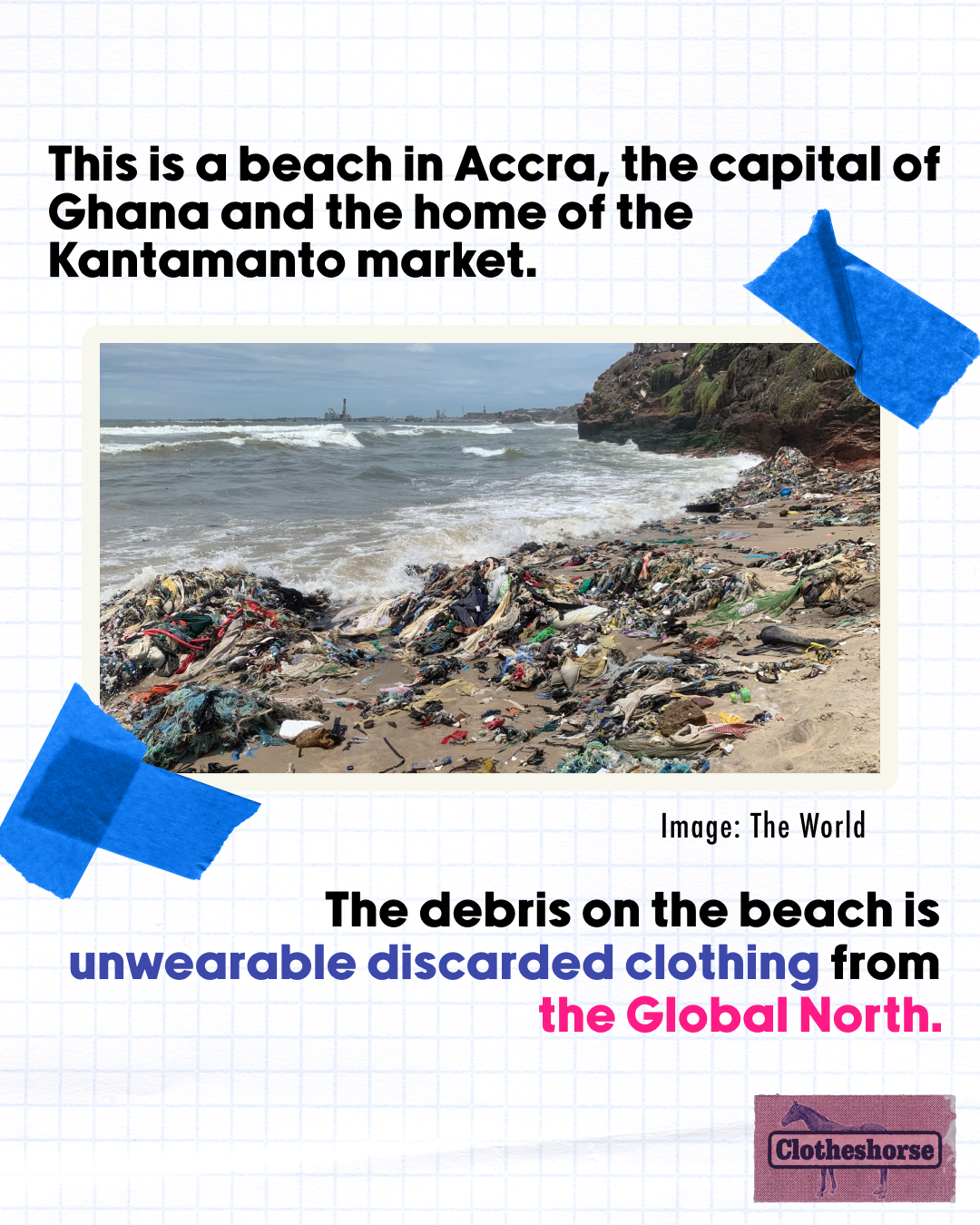
Every week, 15 million secondhand garments from the Global North arrive in Kantamanto (Accra, Ghana)
40% of this clothing leaves the market as waste, often within 1-2 weeks of arriving at the port in Accra.
This is just one port among many around the world that become the final stop for the unwanted clothing of the Global North.
What happens to this clothing waste in Accra? It ends up in burn piles around the city, dumped in informal settlements (polluting areas were Accra’s most vulnerable residents live), or washed out to sea, where it harms aquatic life, makes the work of fishermen more dangerous, and breaks down into microplastics/works its way into the food chain.
This deluge of low quality, barely worn clothing plunges resellers into debt, destroys the local apparel industry, and fosters an economy based on cheap and dangerous labor where young women work as kayayei (head porters), transporting bales across the market on their heads.
This unhappy ending is not unique to Accra, as the Global North exports unwanted clothing to other ports throughout the Global South.
According to the British Fashion Council, there is already enough clothing on this planet to dress the next six generations of people.
It is imperative that we get as much wear as possible out of the clothing that already exists.
Some experts believe that our planet’s future depends on all of us buying 75% less brand new clothing. That means opting for secondhand as often as possible.
And that will mean EVERYONE buying from resellers, secondhand shops, thrift stores, and other secondhand shopping options like yard sales, flea markets, etc.
When we tell people that they are too “rich” or too “something else” to shop secondhand/thrift, we are steering them into fast fashion. Why? Because in 2025, most retailers/brands have adopted the fast fashion model. That means selling us low quality/poorly fitting clothing (regardless of price) that will need to be replaced often.
Furthermore, people are going to buy clothing. Period. Bodies change, lives change. People move around, get new jobs, get older, get sick, and on and on. These changes are often accompanied by a need for different clothing.
Knowing that people of all income levels will need clothing…let’s ensure that they are opting for secondhand clothing by encouraging secondhand shopping (not stigmatizing it).
If you want to share your opinion/additional thoughts on the subjects we cover in each episode, feel free to email, whether it’s a typed out message or an audio recording: amanda@clotheshorse.world
Deco Denim is a startup based out of San Francisco, selling clothing and accessories that are sustainable, gender fluid, size inclusive and high quality–made to last for years to come. Deco Denim is trying to change the way you think about buying clothes. Founder Sarah Mattes wants to empower people to ask important questions like, “Where was this made? Was this garment made ethically? Is this fabric made of plastic? Can this garment be upcycled and if not, can it be recycled?” Signup at decodenim.com to receive $20 off your first purchase. They promise not to spam you and send out no more than 3 emails a month, with 2 of them surrounding education or a personal note from the Founder. Find them on Instagram as @deco.denim.
Selina Sanders, a social impact brand that specializes in up-cycled clothing, using only reclaimed, vintage or thrifted materials: from tea towels, linens, blankets and quilts. Sustainably crafted in Los Angeles, each piece is designed to last in one’s closet for generations to come. Maximum Style; Minimal Carbon Footprint.
Republica Unicornia Yarns: Hand-Dyed Yarn and notions for the color-obsessed. Made with love and some swearing in fabulous Atlanta, Georgia by Head Yarn Wench Kathleen. Get ready for rainbows with a side of Giving A Damn! Republica Unicornia is all about making your own magic using small-batch, responsibly sourced, hand-dyed yarns and thoughtfully made notions. Slow fashion all the way down and discover the joy of creating your very own beautiful hand knit, crocheted, or woven pieces. Find us on Instagram @republica_unicornia_yarns and at www.republicaunicornia.com.
Cute Little Ruin is an online shop dedicated to providing quality vintage and secondhand clothing, vinyl, and home items in a wide range of styles and price points. If it’s ethical and legal, we try to find a new home for it! Vintage style with progressive values. Find us on Instagram at @CuteLittleRuin.