It was a trip we had been planning for seven months! In October, I bought tickets to see two Belle + Sebastian shows as an anniversary gift to both of us.
Well, much like “rain on your wedding day” or “a black fly in your chardonnay” (neither of these things are ironic btw)…sometimes life just brings you some disappointing moments. And while we were on this trip to one of my favorite places in the world, I got sick with norovirus.
Really. Fucking. Sick.
Like “three days in bed sick.”
Like “crying because you are just so miserable” sick.
Like “wondering if I was going to die in another country” sick.
My digestive tract is the weakest part of my body, thanks to an autoimmune disease that has been attacking my guts since I was a kid. So when I get a stomach bug, it’s really horrible.
I missed both shows. I missed our dinner reservation at Rosetta. I missed art museums, tacos, and flea markets. But that’s just how life goes sometimes. I am lucky. I have had many incredible trips to Mexico City in the past. There will be other shows, good food, and art in the future.
But it gave me a lot of time to think…well, after I got through the phase of whispering “please don’t throw up” over and over to myself.
About five years ago, Dustin and I were on a road trip. We don’t really eat very “junk food” as adults. My stomach can’t handle it. But at a gas station, we started eyeing up the Little Debbie display.
“Remember when these were just 25 cents?” We laughed at how we were starting to sound like grandpas. But we both had to agree: growing up poor in rural areas, we had eaten a lot of cheap Little Debbie snacks as kids. So we decided to buy a Nutty Bar (now called Nutty Buddy) out of nostalgia.
But by the time we each took a bite in the car, we were disappointed. Our lips were covered with a greasy film from the flavorless “chocolate” coating. The peanut butter filling was more like hearing someone saying the words “peanut butter” and expecting to taste it in your mouth. We didn’t finish the Nutty Bar. And we also declined to add it to the compost can at home. It felt too “food science” for our garden.
Of course a disappointing experience like this was followed with a familiar conversation: Were we just remembering Nutty Bars as better than they really were? Had they actually gotten worse over time? Or perhaps the problem was us…maybe we had “outgrown” Nutty Bars as our palates changed. We decided we must be the issue.
But this situation played itself out over and over again with packaged foods, restaurants, tourist spots, trips to the mall, and so on. We always thought we were the problem: we remembered things as better than they really were. Avoiding disappointment meant forgetting our past experiences.
And yet, we could revisit something that had been preserved in amber for decades – a film, a beloved book, a favorite album – and those things were just as good, maybe even better than we remembered.
It’s easy to look around and spot the decreasing quality around us:
Fast fashion clothes: mostly plastic, poor fitting, and short lived.
Air travel: smaller seats, no free bags, no food on planes. As a kid, I flew by myself from Harrisburg, PA to Portland, OR and I was served FOUR meals, including a really great breakfast burrito.
Packaged foods: smaller sizes and declining ingredients.
The thing is…this didn’t happen overnight. t’s all the result of decades of companies chasing higher profits year after year. That’s the thing about our current system: businesses are expected to be more profitable this year than last year. And next year, they will be more profitable than this year. And for a few years, it’s easy to do that by finding efficiencies and negotiating better prices. But after decades, it’s time to start cutting corners. And that’s where we are now.
The fast fashion clothes of the 00s were exponentially better quality than they are now.
Until 2008, you could check bags for free on flights.
And yeah, a lot of packaged foods WERE better twenty years ago.
I think we were distracted for a long time by new, exciting technology like social media, online shopping, apps, games, and streaming services. Maybe food and clothes weren’t feeling as “good” and satisfying as they once were, but now we had an endless array of things to buy on the internet. The world was at our fingertips (and on our phones). It felt like there was an infinite amount of music, movies, and shows to watch.
But over the past few years, the social media apps were flooded with rage bait, misinformation, and (of course) advertising. The quality of the streaming apps declined while the prices went up. The stuff we were buying online was plentiful…but increasingly disappointing. Blogs and journalism began to disappear from the internet, replaced by “advertorial” content with affiliate links. Even search results got kinda…well, shitty.
Last week, while I was shivering under two blankets, despite the May heat in Mexico City, my head was spinning with this decline of EVERYTHING. How much worse could things get? Would anything ever be truly good again? And where could we expect to find joy in an increasingly scary, unjust world? Over the next few days, as I shifted from this liminal state of miserable semi-consciousness to finally sitting up and eating a bowl of rice, I continued to ponder all of this.
On our last full day in Mexico City, I was well enough to get out of bed, take a shower, and go out into the world. We visited Museo Tamayo, a great contemporary art museum on the edge of Bosque de Chapultepec (“Chapultepec Forest,” one of the biggest parks in Mexico).
One of the current exhibitions is called “Futuros Arcaicos” (Archaic Futures). The show brought together work from modern and contemporary artists who found inspiration in the archaic, the cosmic, and the mythological as potential lenses for envisioning the future. Most of our glimpses of the future tend to be science fiction, shaped by technological advancement. The work of the artists in this exhibition imagined that human’s future would be shaped more by our past, by archaic tools and ways.
When I say that art is a precious gift to our world, a magical thing that can only be created by humans, I really, really mean that. Because art makes us feel (even when we don’t like it). And it makes us think (even if those thoughts make us uncomfortable).
And as I was looking at that art, thinking about it then…and then hours and days later…it slowly folded itself into my ruminations about enshittification. And I began to see some light. Some answers. A path forward.
It feels right now that we cannot rely on anything we once could to bring us joy. We’re always left a little hungry, a little disappointed, a little lingering feeling of “meh.”
But I am here to tell you that joy and satisfaction still exist. It’s probably not in our phones. Odds are high that you can’t find it in a mall or on an app. But it’s out there, and there’s a lot of it…plenty to go around.
Here’s what hasn’t been enshittified:
Making something yourself. Whether it’s food, clothes, or art, making something yourself is about the joy of the process, sometimes more than the finished product. The same goes for repairing something.
Finding the answer and learning something along the way. Learning is really one of life’s simplest pleasures.
Connecting with the humans and animals around you, finding your community and your people. Working together on something or sharing your knowledge and stories with one another.
Experiencing the magic of this planet, whether it’s going outside or growing some herbs on your windowsill. Seriously I kinda can’t believe how all of this exists!!
This is just the beginning of the list of good things left in this world. One thing they all have in common? They are all pretty archaic. This is stuff humans have been doing kinda forever. We tend to expect that things that are “archaic” feel out-of-date and would be completely out of place in our current times, much less in the future. et reconnecting with our humanity, the power of our brains, our creativity, and our communities feels more vital and powerful than ever. And sure, technology can be helpful for finding your community, learning new stuff, making a new friend, or getting some answers. But none of it means anything without humans, our brains, and all of the archaic stuff we’ve been doing for the last 300,000 years.
Realizing that we already have the tools to find joy and satisfaction makes me feel hopeful in a way that I have not in a long time.
Yes, there are obstacles.
Yes, we have our work cut out for us.
But I believe that the future can be better than any of us have been picturing. And if I can’t have the high tech, post capitalism future of Star Trek, at least I know that what we do next can and will be good.
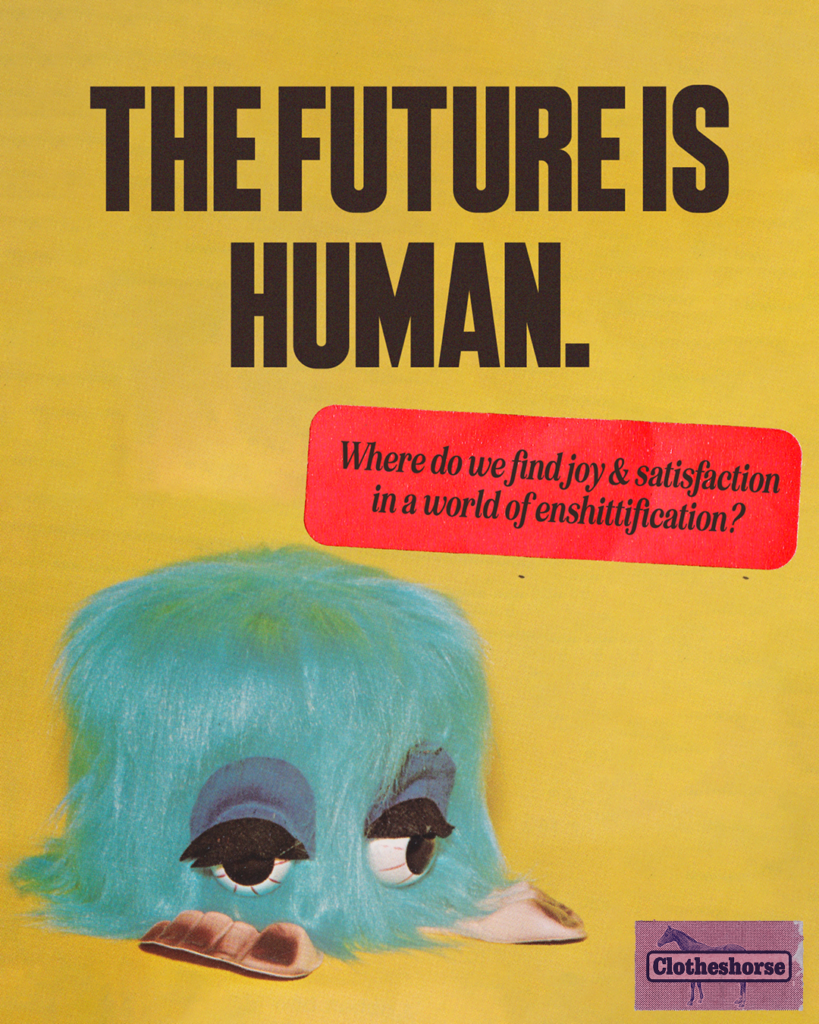
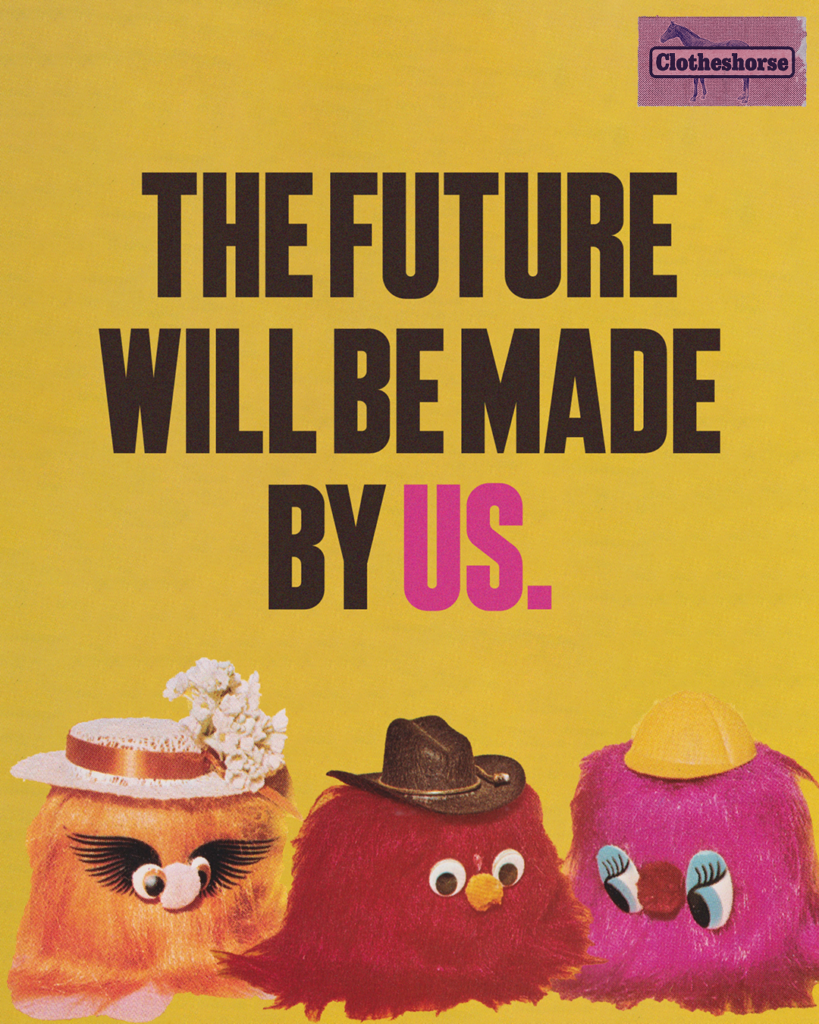
About this post: as always, Clotheshorse is an anti-AI zone. First, I outlined this post on the flight home yesterday. Today and I sat down and wrote it. The images in this post came from a vintage craft magazine called YOU CAN MAKE FURRY NOVELTIES. I scanned them and then edited them in Photoshop. The post was assembled in Figma. The entire process from beginning to end took 4 hours. Thanks for reading it!
Your list may vary (because values are extremely personal):
Amazon, Walmart, Target, SHEIN, Temu…basically any company with opaque supply chains and labor issues.
Companies like Trader Joes and Starbucks who engage in anti-union tactics.
Brands who refused to #PayUp on orders cancelled in 2020: all the URBN brands, American Eagle, Aerie, TJ Maxx, Home Goods, Marshalls, Ross, Kohl’s, Forever 21, and more.
Any company with an obvious political stance that does not fit my own values. Yeah, that means I won’t be renting a truck from the U-Haul place in my town with a massive Trump sign. Definitely not buying cookies from this terrible viral cookie place here in Lancaster County.
That’s just the beginning of my list. Most importantly, I try to shop secondhand first. And when I can’t do that, I start by looking for something local from a small business.
My thought process as I make decisions about where and when to shop:
First things first: do I really need this? Is it more of a want?
If it’s clothing: why do I need it? When and how will I wear it? Am I prepared to care for it properly and mend it when necessary?
If it’s not clothing, where will it live in my home? Can I see myself using this thing for a long time?
Can I find it secondhand? Often I’ll look online and in person for this item, for days, weeks, even months (if it is not urgent).
If I can’t find it secondhand, can I find it from a local small business? That means my money will stay within the community.
If I can’t find it locally, can I find it elsewhere from a small business? My money has more immediate impact with a small business.
If I still can’t find it, but definitely need it…then I’ll buy it elsewhere.
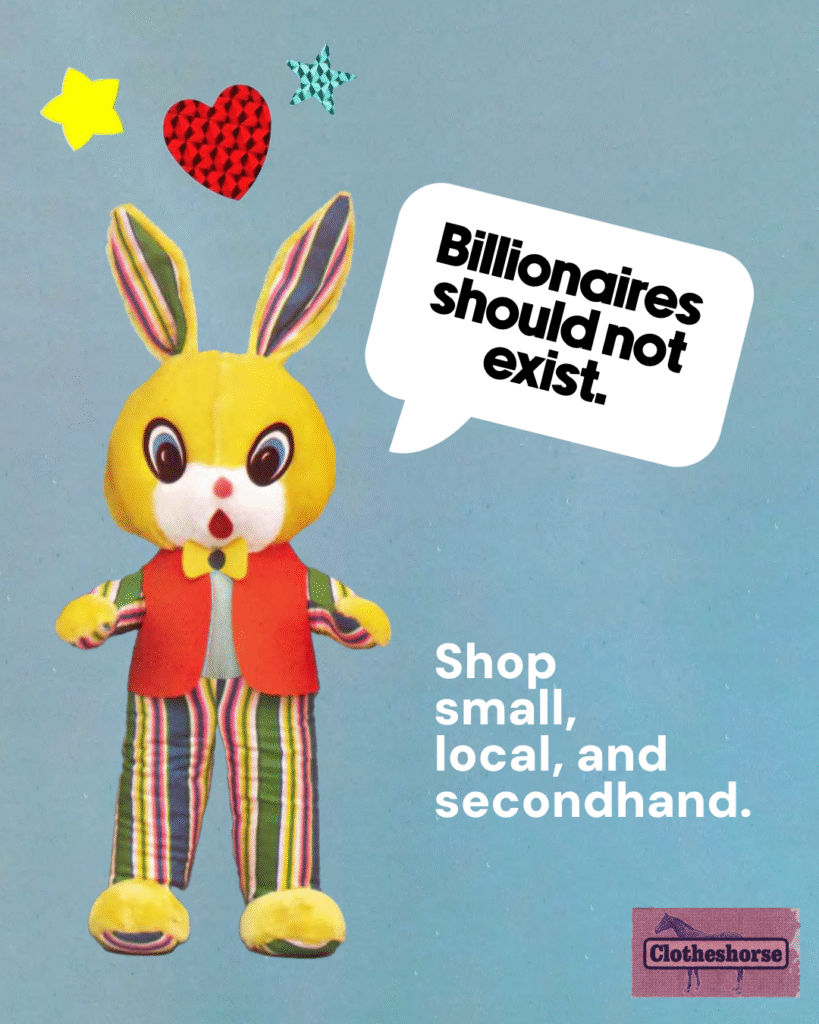
The last thing I want to add here: odds are good that your favorite small business isn’t planning on buying an election, gutting the federal government, or blasting rockets into the atmosphere. So shop small when you can!
If you want to share your opinion/additional thoughts on the subjects we cover in each episode, feel free to email, whether it’s a typed out message or an audio recording: amanda@clotheshorse.world
Deco Denim is a startup based out of San Francisco, selling clothing and accessories that are sustainable, gender fluid, size inclusive and high quality–made to last for years to come. Deco Denim is trying to change the way you think about buying clothes. Founder Sarah Mattes wants to empower people to ask important questions like, “Where was this made? Was this garment made ethically? Is this fabric made of plastic? Can this garment be upcycled and if not, can it be recycled?” Signup at decodenim.com to receive $20 off your first purchase. They promise not to spam you and send out no more than 3 emails a month, with 2 of them surrounding education or a personal note from the Founder. Find them on Instagram as @deco.denim.
Selina Sanders, a social impact brand that specializes in up-cycled clothing, using only reclaimed, vintage or thrifted materials: from tea towels, linens, blankets and quilts. Sustainably crafted in Los Angeles, each piece is designed to last in one’s closet for generations to come. Maximum Style; Minimal Carbon Footprint.
Republica Unicornia Yarns: Hand-Dyed Yarn and notions for the color-obsessed. Made with love and some swearing in fabulous Atlanta, Georgia by Head Yarn Wench Kathleen. Get ready for rainbows with a side of Giving A Damn! Republica Unicornia is all about making your own magic using small-batch, responsibly sourced, hand-dyed yarns and thoughtfully made notions. Slow fashion all the way down and discover the joy of creating your very own beautiful hand knit, crocheted, or woven pieces. Find us on Instagram @republica_unicornia_yarns and at www.republicaunicornia.com.
Cute Little Ruin is an online shop dedicated to providing quality vintage and secondhand clothing, vinyl, and home items in a wide range of styles and price points. If it’s ethical and legal, we try to find a new home for it! Vintage style with progressive values. Find us on Instagram at @CuteLittleRuin.