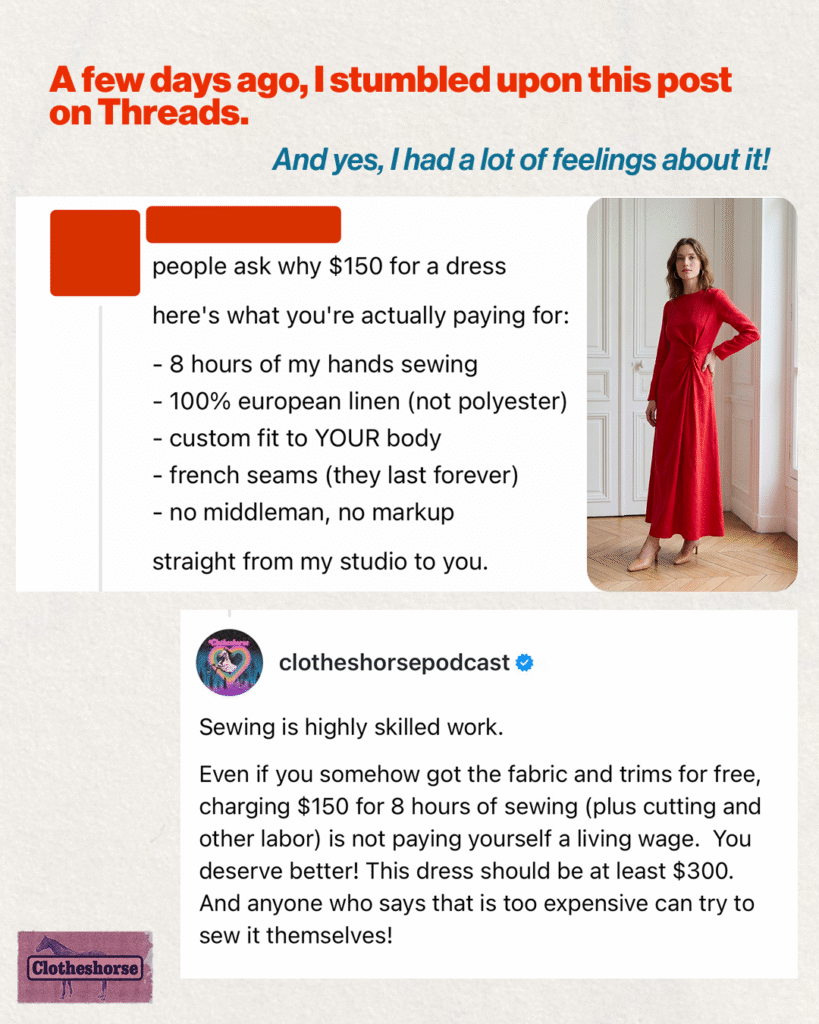
How could someone ever make a living selling a dress like this for $150? The answer is…no one could make a living selling that dress for $150. Let’s think about the expenses associated with making and selling that dress:
If somehow 2-6 were free (spoiler: that’s just not possible), that means that someone was paid $18.75 for the highly skilled, physically demanding work of sewing that dress. That’s not a living wage. And if you think $18.75 is “fine,” I want to ask you: are you willing to sew all day for $18.75/hour?
But even worse: we know that the fabric was not free. We know that the platform took a cut . We know that the packaging cost money. We know that there was a whole lot of extra labor involved. A small business owner selling a dress for $150 is probably making minimum wage, at best. And we know that is not a living wage.
I always say “It’s cheap because someone didn’t get paid.” But also, sometimes it’s still too cheap for someone to actually get paid fairly…even when the price is a lot higher than SHEIN or Zara. That’s just how much exploitation and cut corners are baked into the fast fashion model. Fast fashion prices are really that far away from making sense!
I have been working with small businesses for five years, as a coach, advisor, and teacher. The problem I encounter most often? Business owners who are not paying themselves, or paying themselves so little that it feels cruel.
Sure, sometimes when you’re starting a business you just can’t pay yourself. I get that. But what I see happening is this: the business starts off with pricing that will never accommodate anyone getting paid to do the work of running that business and making the products it sells. And at some point, it begins to feel “too late” to fix that.
And to be clear: every human deserves a safe, happy, healthy life. And in a capitalist system, that means they need to be paid enough to afford food, shelter, healthcare, clothes, and fun. Furthermore, they need to be able to take time off, to rest, to get inspired, to spend time with loved ones. That means being paid a living wage for their work.
If you’ve read this far, either you’re already drafting up a spicy response for the comment section…or you’re wondering what the solution is. How do we fix this disconnect in pricing and customer expectations?
I wish I could say it was something simple. “Do xyz and voila! Everyone gets paid and no one ever leaves a comment on a small business post about something being too expensive.” Yeah, that’s not going to happen.
There is a path forward, but it involves work from EVERYONE: small business owners and customers alike. And this work is worthwhile because our current expectations about price are…super unethical.
My final advice for small businesses: when one business underprices, it forces everyone else to underprice. And so pricing your products to cover a living wage actually lifts up every small business around you. We have gotten used to the artificially low prices of fast fashion because we are surrounded by cheap, low quality goods. We can get used to paying ethical prices when they are the rule, not the exception.
Your list may vary (because values are extremely personal):
Amazon, Walmart, Target, SHEIN, Temu…basically any company with opaque supply chains and labor issues.
Companies like Trader Joes and Starbucks who engage in anti-union tactics.
Brands who refused to #PayUp on orders cancelled in 2020: all the URBN brands, American Eagle, Aerie, TJ Maxx, Home Goods, Marshalls, Ross, Kohl’s, Forever 21, and more.
Any company with an obvious political stance that does not fit my own values. Yeah, that means I won’t be renting a truck from the U-Haul place in my town with a massive Trump sign. Definitely not buying cookies from this terrible viral cookie place here in Lancaster County.
That’s just the beginning of my list. Most importantly, I try to shop secondhand first. And when I can’t do that, I start by looking for something local from a small business.
My thought process as I make decisions about where and when to shop:
First things first: do I really need this? Is it more of a want?
If it’s clothing: why do I need it? When and how will I wear it? Am I prepared to care for it properly and mend it when necessary?
If it’s not clothing, where will it live in my home? Can I see myself using this thing for a long time?
Can I find it secondhand? Often I’ll look online and in person for this item, for days, weeks, even months (if it is not urgent).
If I can’t find it secondhand, can I find it from a local small business? That means my money will stay within the community.
If I can’t find it locally, can I find it elsewhere from a small business? My money has more immediate impact with a small business.
If I still can’t find it, but definitely need it…then I’ll buy it elsewhere.
The last thing I want to add here: odds are good that your favorite small business isn’t planning on buying an election, gutting the federal government, or blasting rockets into the atmosphere. So shop small when you can!
If you want to share your opinion/additional thoughts on the subjects we cover in each episode, feel free to email, whether it’s a typed out message or an audio recording: [email protected]
Slow Fashion Academy is a size-inclusive sewing and patternmaking studio based in Philadelphia, Pennsylvania. Designer and fashion professor Ruby Gertz teaches workshops for hobbyists and aspiring designers, so that anyone can learn the foundational skills of making, mending, and altering their own clothes. Ruby also provides professional design and patternmaking services to emerging slow fashion brands, and occasionally takes commissions for custom garments and costume pieces. She has also released several PDF sewing patterns for original designs under her brands Spokes & Stitches, and Starling Petite Plus. Check the schedule for upcoming workshops, download PDF sewing patterns, and learn about additional sewing and design services at www.slowfashion.academy.
Thumbprint is Detroit’s only fair trade marketplace, located in the historic Eastern Market. Our small business specializes in products handmade by empowered women in South Africa making a living wage creating things they love like hand painted candles and ceramics! We also carry a curated assortment of sustainable/natural locally made goods. Thumbprint is a great gift destination for both the special people in your life and for yourself! Browse our online store at thumbprintdetroit.com and find us on instagram @thumbprintdetroit.
Picnicwear: a slow fashion brand, ethically made by hand from vintage and deadstock materials – most notably, vintage towels! Founder, Dani, has worked in the industry as a fashion designer for over 10 years, but started Picnicwear in response to her dissatisfaction with the industry’s shortcomings. Picnicwear recently moved to rural North Carolina where all their clothing and accessories are now designed and cut, but the majority of their sewing is done by skilled garment workers in NYC. Their customers take comfort in knowing that all their sewists are paid well above NYC minimum wage. Picnicwear offers minimal waste and maximum authenticity: Future Vintage over future garbage.
Shift Clothing, out of beautiful Astoria, Oregon, with a focus on natural fibers, simple hardworking designs, and putting fat people first. Discover more at shiftwheeler.com
High Energy Vintage is a fun and funky vintage shop located in Somerville, MA, just a few minutes away from downtown Boston. They offer a highly curated selection of bright and colorful clothing and accessories from the 1940s-1990s for people of all genders. Husband-and-wife duo Wiley & Jessamy handpick each piece for quality and style, with a focus on pieces that transcend trends and will find a home in your closet for many years to come! In addition to clothing, the shop also features a large selection of vintage vinyl and old school video games. Find them on instagram @ highenergyvintage, online at highenergyvintage.com, and at markets in and around Boston.
St. Evens is an NYC-based vintage shop that is dedicated to bringing you those special pieces you’ll reach for again and again. More than just a store, St. Evens is dedicated to sharing the stories and history behind the garments. 10% of all sales are donated to a different charitable organization each month. New vintage is released every Thursday at wearStEvens.com, with previews of new pieces and more brought to you on Instagram at @wear_st.evens.
Deco Denim is a startup based out of San Francisco, selling clothing and accessories that are sustainable, gender fluid, size inclusive and high quality–made to last for years to come. Deco Denim is trying to change the way you think about buying clothes. Founder Sarah Mattes wants to empower people to ask important questions like, “Where was this made? Was this garment made ethically? Is this fabric made of plastic? Can this garment be upcycled and if not, can it be recycled?” Signup at decodenim.com to receive $20 off your first purchase. They promise not to spam you and send out no more than 3 emails a month, with 2 of them surrounding education or a personal note from the Founder. Find them on Instagram as @deco.denim.
The Pewter Thimble Is there a little bit of Italy in your soul? Are you an enthusiast of pre-loved decor and accessories? Bring vintage Italian style — and history — into your space with The Pewter Thimble (@thepewterthimble). We source useful and beautiful things, and mend them where needed. We also find gorgeous illustrations, and make them print-worthy. Tarot cards, tea towels and handpicked treasures, available to you from the comfort of your own home. Responsibly sourced from across Rome, lovingly renewed by fairly paid artists and artisans, with something for every budget. Discover more at thepewterthimble.com
Blank Cass, or Blanket Coats by Cass, is focused on restoring, renewing, and reviving the history held within vintage and heirloom textiles. By embodying and transferring the love, craft, and energy that is original to each vintage textile into a new garment, I hope we can reteach ourselves to care for and mend what we have and make it last. Blank Cass lives on Instagram @blank_cass and a website will be launched soon at blankcass.com.
Vagabond Vintage DTLV is a vintage clothing, accessories & decor reselling business based in Downtown Las Vegas. Not only do we sell in Las Vegas, but we are also located throughout resale markets in San Francisco as well as at a curated boutique called Lux and Ivy located in Indianapolis, Indiana. Jessica, the founder & owner of Vagabond Vintage DTLV, recently opened the first IRL location located in the Arts District of Downtown Las Vegas on August 5th. The shop has a strong emphasis on 60s & 70s garments, single stitch tee shirts & dreamy loungewear. Follow them on instagram, @vagabondvintage.dtlv and keep an eye out for their website coming fall of 2022.
Country Feedback is a mom & pop record shop in Tarboro, North Carolina. They specialize in used rock, country, and soul and offer affordable vintage clothing and housewares. Do you have used records you want to sell? Country Feedback wants to buy them! Find us on Instagram @countryfeedbackvintageandvinyl or head downeast and visit our brick and mortar. All are welcome at this inclusive and family-friendly record shop in the country!
Located in Whistler, Canada, Velvet Underground is a “velvet jungle” full of vintage and second-hand clothes, plants, a vegan cafe and lots of rad products from other small sustainable businesses. Our mission is to create a brand and community dedicated to promoting self-expression, as well as educating and inspiring a more sustainable and conscious lifestyle both for the people and the planet. Find us on Instagram @shop_velvetunderground or online at www.shopvelvetunderground.com
Selina Sanders, a social impact brand that specializes in up-cycled clothing, using only reclaimed, vintage or thrifted materials: from tea towels, linens, blankets and quilts. Sustainably crafted in Los Angeles, each piece is designed to last in one’s closet for generations to come. Maximum Style; Minimal Carbon Footprint.
Salt Hats: purveyors of truly sustainable hats. Hand blocked, sewn and embellished in Detroit, Michigan.
Republica Unicornia Yarns: Hand-Dyed Yarn and notions for the color-obsessed. Made with love and some swearing in fabulous Atlanta, Georgia by Head Yarn Wench Kathleen. Get ready for rainbows with a side of Giving A Damn! Republica Unicornia is all about making your own magic using small-batch, responsibly sourced, hand-dyed yarns and thoughtfully made notions. Slow fashion all the way down and discover the joy of creating your very own beautiful hand knit, crocheted, or woven pieces. Find us on Instagram @republica_unicornia_yarns and at www.republicaunicornia.com.
Cute Little Ruin is an online shop dedicated to providing quality vintage and secondhand clothing, vinyl, and home items in a wide range of styles and price points. If it’s ethical and legal, we try to find a new home for it! Vintage style with progressive values. Find us on Instagram at @CuteLittleRuin.