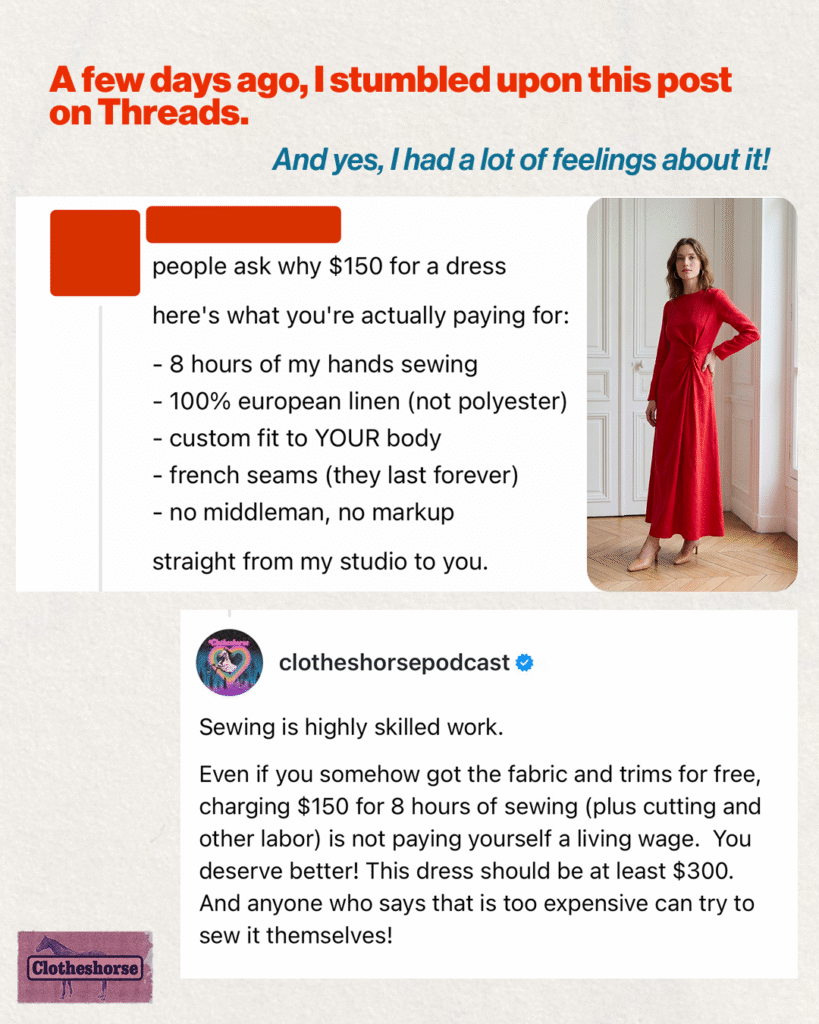
How could someone ever make a living selling a dress like this for $150? The answer is…no one could make a living selling that dress for $150.  Let’s think about the expenses associated with making and selling that dress:

  1. 8 hours of sewing
  2. Fabric
  3. Any trims (zipper, buttons, hook and eye, elastic, label, etc)
  4. Packaging for shipping
  5. Platform fees (whether it’s sold on Etsy, Shopify, Square, or any other platform, someone is taking a cut)
  6. The time spent creating the listing, doing customer service, posting on social media, sending out marketing emails, taking photos, sourcing fabric, creating a pattern, testing the pattern, and so on.

If somehow 2-6 were free (spoiler: that’s just not possible), that means that someone was paid $18.75 for the highly skilled, physically demanding work of sewing that dress.  That’s not a living wage. And if you think $18.75 is “fine,” I want to ask you: are you willing to sew all day for $18.75/hour?

But even worse: we know that the fabric was not free.  We know that the platform took a cut . We know that the packaging cost money.  We know that there was a whole lot of extra labor involved.  A small business owner selling a dress for $150 is probably making minimum wage, at best.  And we know that is not a living wage.  

I always say “It’s cheap because someone didn’t get paid.” But also, sometimes it’s still too cheap for someone to actually get paid fairly…even when the price is a lot higher than SHEIN or Zara.  That’s just how much exploitation and cut corners are baked into the fast fashion model. Fast fashion prices are really that far away from making sense!

I have been working with small businesses for five years, as a coach, advisor, and teacher.  The problem I encounter most often? Business owners who are not paying themselves, or paying themselves so little that it feels cruel.

Sure, sometimes when you’re starting a business you just can’t pay yourself.  I get that.  But what I see happening is this: the business starts off with pricing that will never accommodate anyone getting paid to do the work of running that business and making the products it sells. And at some point, it begins to feel “too late” to fix that.

Why are businesses offering these unrealistically low prices?

  • Fast fashion has turned our perception of price and value completely upside down.  Customers have a new baseline for price expectations and anything above that is deemed “too expensive.”  
  • Of course, here in the slow fashion community we know that fast fashion prices are built on human exploitation and low quality.  But we are still in the minority.  We need more people to know the truth about those prices: that they are actually a bad deal for everyone (the planet, the workers, AND the customers).
  • That said, even small businesses who know the truth about fast fashion pricing (and how it is melting everyone’s brains) still feel that pressure from customers to keep things “affordable.” The problem with these “affordable” prices? They are great for customers and bad for everyone else.
  • To make matters even more complicated, many small businesses are community minded…and they want to keep their products accessible to everyone. And in a world where everyone (except for billionaires and executives) is underpaid, overworked, and feeling broke, that means that prices need to stay low in order to be accessible.  

The implications of these low prices are all around us:

  • These low prices have a halo effect: if one small business underprices their products, then every other business has to follow suit or lose out on sales. So now EVERYONE is unable to pay themselves, much less pay someone to help them.
  • These unrealistic prices from small businesses just reinforce the validity of the artificially low prices that fast fashion offers. 
  • Even worse, these low prices just devalue the work involved in making products and running a business, reinforcing the illusion that this work is “unskilled,” something that anyone can do well.  And that helps fast everything companies get away with continuing to underpay and exploit workers around the world.
  • Small businesses close up shop because they can’t make enough money to stay in business.  Or the owner gets so burned out from working 24/7…and still finding out they can’t pay their bills at the end of the month.
  • When small businesses close, that pushes customers toward the same fast “everything” megacorporations that have built their businesses off of human exploitation and low quality.  This just exacerbates economic inequality. 

And to be clear: every human deserves a safe, happy, healthy life.  And in a capitalist system, that means they need to be paid enough to afford food, shelter, healthcare, clothes, and fun.  Furthermore, they need to be able to take time off, to rest, to get inspired, to spend time with loved ones.  That means being paid a living wage for their work.

If you’ve read this far, either you’re already drafting up a spicy response for the comment section…or you’re wondering what the solution is.  How do we fix this disconnect in pricing and customer expectations? 

I wish I could say it was something simple.  “Do xyz and voila! Everyone gets paid and no one ever leaves a comment on a small business post about something being too expensive.”  Yeah, that’s not going to happen.

There is a path forward, but it involves work from EVERYONE: small business owners and customers alike. And this work is worthwhile because our current expectations about price are…super unethical. 

What small businesses can do:

  • Take the time to sit down and work out how much a product actually costs you to make…if someone were being paid a living wage to make it.  That includes materials, platform fees, packaging, and LABOR.  Does the price you are charging customers actually cover that? If the answer is “no,” now is a good time to create a plan to get there.  It will never happen if you don’t start working toward it now.
  • Increasing prices is actually a great opportunity to educate your customers about the work that goes into making your product and running a small business. Remember: most people just don’t know.  Fast fashion has warped their perception of price and value.  And a lot of people think robots and machines are making most of the stuff we buy.  Is it fair that you have to do this kind of work? No. But this is where we are. And if you’re stuck on how to market your business, sharing this kind of information and education can turn into a ton of social posts and emails.
  • What about accessibility? I get this. I also want everyone to have access to high quality, ethical stuff.  But I often see small business owners not paying themselves so that they can offer the lowest prices.  How is that fair? It’s not fair to the small business owner…but it’s also not fair to the customers who will watch the business disappear when the owner is burned out and can no longer continue.  I recommend reserving a portion of every drop/collection for sliding scale pricing (if this is something you can do). You also don’t have to do this. It’s up to you!

My final advice for small businesses: when one business underprices, it forces everyone else to underprice.  And so pricing your products to cover a living wage actually lifts up every small business around you.  We have gotten used to the artificially low prices of fast fashion because we are surrounded by cheap, low quality goods. We can get used to paying ethical prices when they are the rule, not the exception.
What everyone else can do:

  • We have to rewire our own perception of price and value.  Once again, the prices of fast fashion/fast everything only “work” because they are built on a foundation of human exploitation and low quality. Just about nothing we buy should be this cheap.  These brands are not doing us a service by offering low prices. Instead, they are making us complicit in wage theft, forced labor, and human exploitation.  They are making us sign on to dangerous and unhealthy working conditions. And in exchange, they are giving us low quality stuff that won’t last very long.
  • When I encounter something from a small brand  that feels too expensive for me–because yes, even I have to do this work to rewire my brain–I ask myself: “What price would make this affordable to me? Does that price make sense when I think about the time to make something, the materials involved, the work of running a business?” And most times I realize that no, it does not. If I can’t afford that item new, I look for something secondhand.  Or I wait and save my money.  The thing about moving away from fast fashion is…we have to slow down the process of buying. Fast fashion relies on us being impatient and thoughtless. We can and will do better.
  • One of the other aspects of our behavior that fast fashion has changed? It has made us think that we need a steady stream of new, trendy stuff.  Guess what? We actually don’t! One good dress > five unsatisfying dresses. And when we prioritize quality over quantity, suddenly the higher prices of small businesses don’t seem so wild, because we need less.  YES, THIS CHANGE IS DIFFICULT. But it’s actually how we lived our lives before the fast fashion era.
  • Spread the knowledge! Remember, most people don’t know that fast fashion pricing is one big exploitative scam…ripping off workers AND customers. We have an amazing opportunity to create a better future. It starts with talking to the people around us.
  • Don’t be a jerk.  If you see something cool that feels too expensive, just walk away. Saying something about it to the seller or in the comments section is not only rude, it actually reinforces those artificial fast fashion prices for everyone who hears or sees your comment. And it means you’re inadvertently doing free PR for fast fashion.
It's cheap because someone didn't get paid.

Companies I avoid…

Your list may vary (because values are extremely personal):

That’s just the beginning of my list. Most importantly, I try to shop secondhand first. And when I can’t do that, I start by looking for something local from a small business.

How I make decisions…

My thought process as I make decisions about where and when to shop:

  1. First things first: do I really need this? Is it more of a want?
    If it’s clothing: why do I need it? When and how will I wear it? Am I prepared to care for it properly and mend it when necessary?
    If it’s not clothing, where will it live in my home? Can I see myself using this thing for a long time?

  2. Can I find it secondhand? Often I’ll look online and in person for this item, for days, weeks, even months (if it is not urgent).

  3. If I can’t find it secondhand, can I find it from a local small business? That means my money will stay within the community.

  4. If I can’t find it locally, can I find it elsewhere from a small business? My money has more immediate impact with a small business.

  5. If I still can’t find it, but definitely need it…then I’ll buy it elsewhere.
 

The last thing I want to add here: odds are good that your favorite small business isn’t planning on buying an election, gutting the federal government, or blasting rockets into the atmosphere. So shop small when you can!

Want to Support Amanda's Work on Clotheshorse?

If you want to share your opinion/additional thoughts on the subjects we cover in each episode, feel free to email, whether it’s a typed out message or an audio recording:  [email protected]

Clotheshorse is brought to you with support from the following sustainable small businesses:

Slow Fashion Academy is a size-inclusive sewing and patternmaking studio based in Philadelphia, Pennsylvania, founded by designer and fashion professor Ruby Gertz. Ruby just launched CLO3D for Custom Fit: a 12-week beginner-friendly online course in virtual patternmaking with CLO3D software. Instead of making sample after sample, you can now customize avatars that match your real body measurements and fit-test garments virtually—before cutting into a single piece of fabric. You can also work from your pre-existing paper or PDF patterns! 
This course is designed to get you over the initial hump to working confidently in the program. It includes 300+ bite-size video lessons spaced out over 12 weeks, weekly live Q&A calls for accountability, a custom body scan to use as a you-sized virtual dress form, and a super supportive community of like-minded designers that are all learning together in a cohort. Perfect for indie patternmakers, emerging designers, or anyone who wants to design clothes that actually fit their one-of-a-kind body.
 
Learn more about the course, as well as our in-person sewing and patternmaking workshops at www.slowfashion.academy.

Deco Denim is a startup based out of San Francisco, selling clothing and accessories that are sustainable, gender fluid, size inclusive and high quality–made to last for years to come. Deco Denim is trying to change the way you think about buying clothes. Founder Sarah Mattes wants to empower people to ask important questions like, “Where was this made? Was this garment made ethically? Is this fabric made of plastic? Can this garment be upcycled and if not, can it be recycled?” Signup at decodenim.com to receive $20 off your first purchase. They promise not to spam you and send out no more than 3 emails a month, with 2 of them surrounding education or a personal note from the Founder. Find them on Instagram as @deco.denim.

Selina Sanders, a social impact brand that specializes in up-cycled clothing, using only reclaimed, vintage or thrifted materials: from tea towels, linens, blankets and quilts.  Sustainably crafted in Los Angeles, each piece is designed to last in one’s closet for generations to come.  Maximum Style; Minimal Carbon Footprint.

Republica Unicornia Yarns: Hand-Dyed Yarn and notions for the color-obsessed. Made with love and some swearing in fabulous Atlanta, Georgia by Head Yarn Wench Kathleen. Get ready for rainbows with a side of Giving A Damn! Republica Unicornia is all about making your own magic using small-batch, responsibly sourced, hand-dyed yarns and thoughtfully made notions. Slow fashion all the way down and discover the joy of creating your very own beautiful hand knit, crocheted, or woven pieces. Find us on Instagram @republica_unicornia_yarns and at www.republicaunicornia.com.

Cute Little Ruin is an online shop dedicated to providing quality vintage and secondhand clothing, vinyl, and home items in a wide range of styles and price points.  If it’s ethical and legal, we try to find a new home for it!  Vintage style with progressive values.  Find us on Instagram at @CuteLittleRuin.