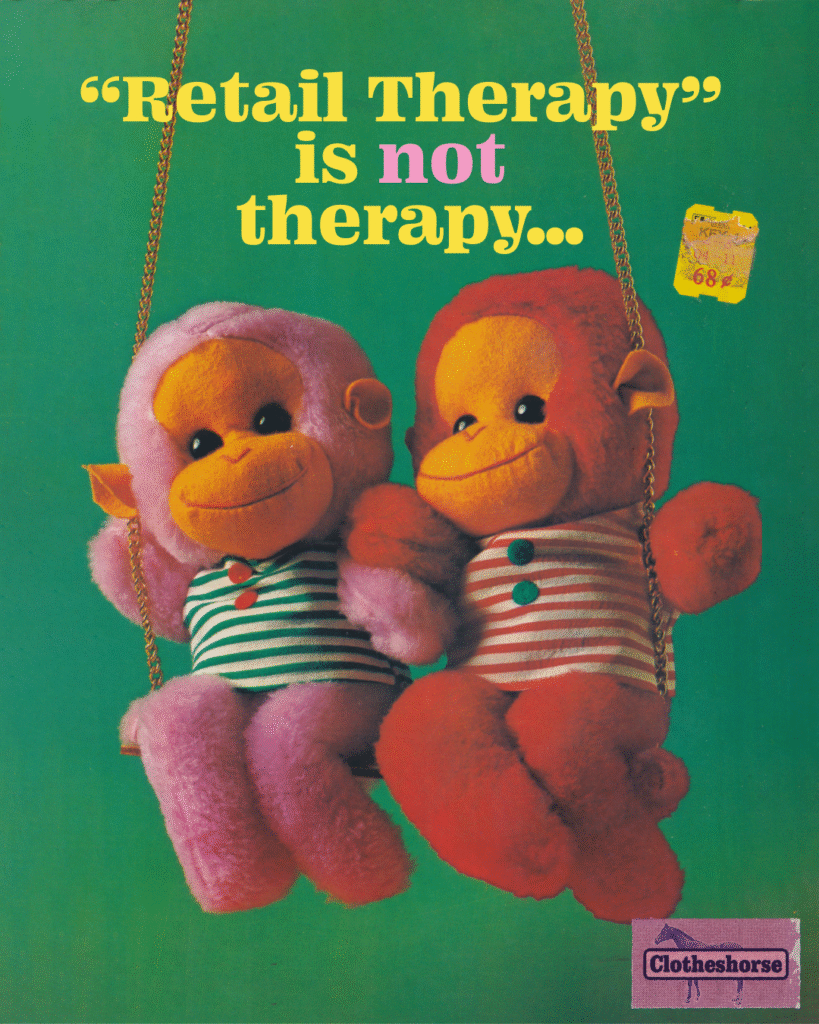
Let’s talk about “retail therapy.”
I’m guilty of using it as a crutch over and over again in my life. I’m sure many of you have found yourself doing the same thing. It’s an easy habit to acquire when it’s part of your family’s regular way of coping with things. When shopping is the only way your family can spend time together. When everyone around you sees encouraging someone to buy something as a way of communicating love and affection.
It’s no wonder that holiday retail sales set a record last year. People are stressed and afraid. Enter…retail therapy.
If you’re struggling with chronic stress, anxiety, bad sleep, a sense of uncontrollable chaos, maybe even hopelessness right now…you are not alone.
There is a direct link between times like this and overconsumption. Many of us have been “programmed” from a young age to cope with bad days via shopping. It can give us a brief break from painful emotions. It might make us feel like we are regaining control of the situations around us.
Chaos and fear are great for fast fashion (and “fast everything”).
But ultimately, it doesn’t really fix anything for us.
My childhood was not great. I dealt with a lot of physical and emotional abuse at home. There were a lot of new stepfathers and new homes. I went to seven different elementary schools. I was always the new weird kid. To make matters worse, I had cancer as a small child and the lingering health issues never went away.
I was definitely in need of long term, intensive therapy. But my family did not believe in that kind of thing.
My grandma would take me shopping when I was having a bad time, which was most of the time. She would pick me up at school early (with the excuse of a fictional doctor’s appointment). And we would go out to lunch, then off to the mall or her favorite department store, Mailman’s (RIP).
I might get a new outfit or some Tinkerbell nail polish. Those afternoons always made me feel better. It probably wasn’t the actual shopping that helped me, but rather that quality time with the one adult who gave me love and affection.
In a family that really struggled to get along, it was the trips to the mall that gave everyone a chance to enjoy one another’s company. My family’s love language was encouraging someone to buy something, telling them that they “deserved” that nice thing.
Shopping was the only activity that brought everyone together. We weren’t a dinner family or a vacation family. We didn’t do outdoor things. The mall was the place where we got to know one another.
It’s no wonder that I think of the mall as a place where magic happens. I don’t want to feel that way, but that illogical belief is engraved on my heart.
The mall is where we forget why we are angry with one another.
The mall is where an otherwise unaffectionate mother might hold your hand.
The mall is where people try to love one another and sometimes succeed.
My child’s father died a few months before they were born. I had to quit my job. My mom had to drive to Chicago, help me pack up all of my stuff in to a U-haul trailer, and bring it to rural PA.
In one week everything I knew was gone. To be an adult who had been living in the city for years, doing all kinds of cool stuff, feeling so optimistic about the future, just full of dreams and plans…And then to quite suddenly be living with my abusive mother in a trailer in rural Pennsylvania, away from all of those dreams and plans… words like “sadness” and “despair” don’t capture my desperation. I couldn’t enjoy books or music. Forget about watching television because inevitably every show or commercial would feature a baby, a family, someone dying, anything that would make me sad.
My mom and grandma would force me to leave the house with them a couple of times a week to go shopping.
Maybe it did kind of work for me? It was something else to think about. It was a reason to get dressed. Even though I was broke with no job and no prospects of a job, I definitely remember buying some super weird stuff during that time, primarily stuff I thought I might want to wear after my child was born. I was buying all of these clothes for this new life that was supposedly coming down the road when all of the pain and sadness was over. I needed to believe that there was a light at the end of the tunnel and maybe buying a new wardrobe would guarantee that better times were coming?
This “retail therapy” didn’t have a name, but it was definitely becoming my go-to treatment for anything that ailed me, no matter how broke I was.
Do we expect the stuff we buy to actually make us feel better? Or is it just the idea that these purchases will create a new future for us?
Shopping never really “fixes” anything for me. Sure, there is the dopamine hit of a new order. There is the daydream of they ways in which my life will be improved by that purchase. There is the distraction of something new. But ultimately, shopping never fixes my problems.
I lost my job, I was consumed with worry about the pandemic, our financial situation, my health, the future of my family…many of you experienced the same thing. And I couldn’t buy something to try to make myself feel better, because there was no money to do that.
I started to think about how shopping tended to be an action with negative results: a negative line on my bank statement and a generally disappointing experience.
What if I could do something that felt like it was part of building something better in my lfe?
Things like going for a walk, talking on the phone with a friend, being affectionate with my partner, having a major petting session with one of my cats, cleaning the house, watching birds, cooking an awesome meal, reading a book, journalling…
These were activities that would improve the quality of my life, while simultaneously building something…whether it was a relationship, a healthy habit, or a creative outlet.
But I’ll tell you this: for all of the improvement I have made in this area, I still catch myself *almost* falling back into the habit. About two years ago, when I was still at my toxic job, I had a really horrible, humiliating day. It was the culmination of months of intensifying stress/anxiety. I had been having a lot of difficult sleeping, eating, caring for myself. On that horrible day, I just completely broke down, crying all night. I couldn’t sleep because my brain was swirling with intrusive thoughts. And at one point—it was probably like 3 am—I sat up and thought “I should go buy something online to cheer myself up.” I got out of bed, grabbed my glasses, and stumbled into my office. I stared blankly at my computer monitor. What could I buy to make myself feel better? I couldn’t think of anything. Not even one thing.
I was sitting there, feeling confused about the whole situation, when Brenda (my cat) jumped on to my lap. We have this thing we do, where she stands on my lap, with her head pressed against my right inner elbow. I wrap my right arm around her, scratching her just above her tail. And while do this, I kiss her head and she purrs like crazy. I forgot about shopping, and just sat there, scratching Brenda and feeling all of her love.
Thanks for letting me share parts of my life with you.
If you’re feeling completely freaked the @#$% out right now, know that you are not alone.
This community is here to listen, distract, support, resist, make up silly songs with you, share cat photos, and learn new stuff together.
Embracing your community is a radical act in a world that encourages individualism and consumerism over caring and sharing.
We will get through this (ALL OF THIS) together.
If you want to share your opinion/additional thoughts on the subjects we cover in each episode, feel free to email, whether it’s a typed out message or an audio recording: amanda@clotheshorse.world
Deco Denim is a startup based out of San Francisco, selling clothing and accessories that are sustainable, gender fluid, size inclusive and high quality–made to last for years to come. Deco Denim is trying to change the way you think about buying clothes. Founder Sarah Mattes wants to empower people to ask important questions like, “Where was this made? Was this garment made ethically? Is this fabric made of plastic? Can this garment be upcycled and if not, can it be recycled?” Signup at decodenim.com to receive $20 off your first purchase. They promise not to spam you and send out no more than 3 emails a month, with 2 of them surrounding education or a personal note from the Founder. Find them on Instagram as @deco.denim.
Selina Sanders, a social impact brand that specializes in up-cycled clothing, using only reclaimed, vintage or thrifted materials: from tea towels, linens, blankets and quilts. Sustainably crafted in Los Angeles, each piece is designed to last in one’s closet for generations to come. Maximum Style; Minimal Carbon Footprint.
Republica Unicornia Yarns: Hand-Dyed Yarn and notions for the color-obsessed. Made with love and some swearing in fabulous Atlanta, Georgia by Head Yarn Wench Kathleen. Get ready for rainbows with a side of Giving A Damn! Republica Unicornia is all about making your own magic using small-batch, responsibly sourced, hand-dyed yarns and thoughtfully made notions. Slow fashion all the way down and discover the joy of creating your very own beautiful hand knit, crocheted, or woven pieces. Find us on Instagram @republica_unicornia_yarns and at www.republicaunicornia.com.
Cute Little Ruin is an online shop dedicated to providing quality vintage and secondhand clothing, vinyl, and home items in a wide range of styles and price points. If it’s ethical and legal, we try to find a new home for it! Vintage style with progressive values. Find us on Instagram at @CuteLittleRuin.