For those of you who are new around here, you might not know that the majority of my career has been in the buying departments of some iconic fast fashion brands. And I saw the switch from “mostly natural fabrics” to “mostly synthetics” during my career! When the 2008 financial crisis forced retailers to drop prices to stay competitive with the early fast fashion brands, everyone had to figure out how to make clothes less expensively (and yet more profitable than ever). The easiest way to get there? Find a cheaper fabric! And guess what’s always cheaper than cotton, linen, silk, or wool? Synthetic fabrics like polyester, nylon, and acrylic.
In the beginning, retailers assumed that ultimately customers would pass on synthetic fabrics and be willing to spend more for natural fibers. But surprise…it turned out that customers didn’t care! So brands began to use them more and more! Synthetic fibers are a master of disguise (even as an expert in this area, I get tricked all the time). And furthermore, they are often blended with natural fibers like cotton, linen, and wool to make them feel softer, cozier, or “more premium.” At this point, there is practically an infinite array of blends out there in the world, making them nearly impossible to recycle.
The most important thing about this series: I am not telling you to stop wearing synthetics. For some categories, synthetic fabrics are the best option right now. Athletic wear is a great example. But I want you to realize the impact of producing them and make them last as long as possible. In this ongoing series, we will unpack how these fabrics are made, their impact on the planet (and people), and how to choose wisely. Let’s get started!
One place you’re probably not expecting to find plastic is in the clothing you wear.
Sure, you know that the buttons and zippers on your clothes are made of plastic, but what about the fabric?
65% of clothing manufactured in recent years is made of synthetic fabrics…and those fabrics are made with plastic fibers.
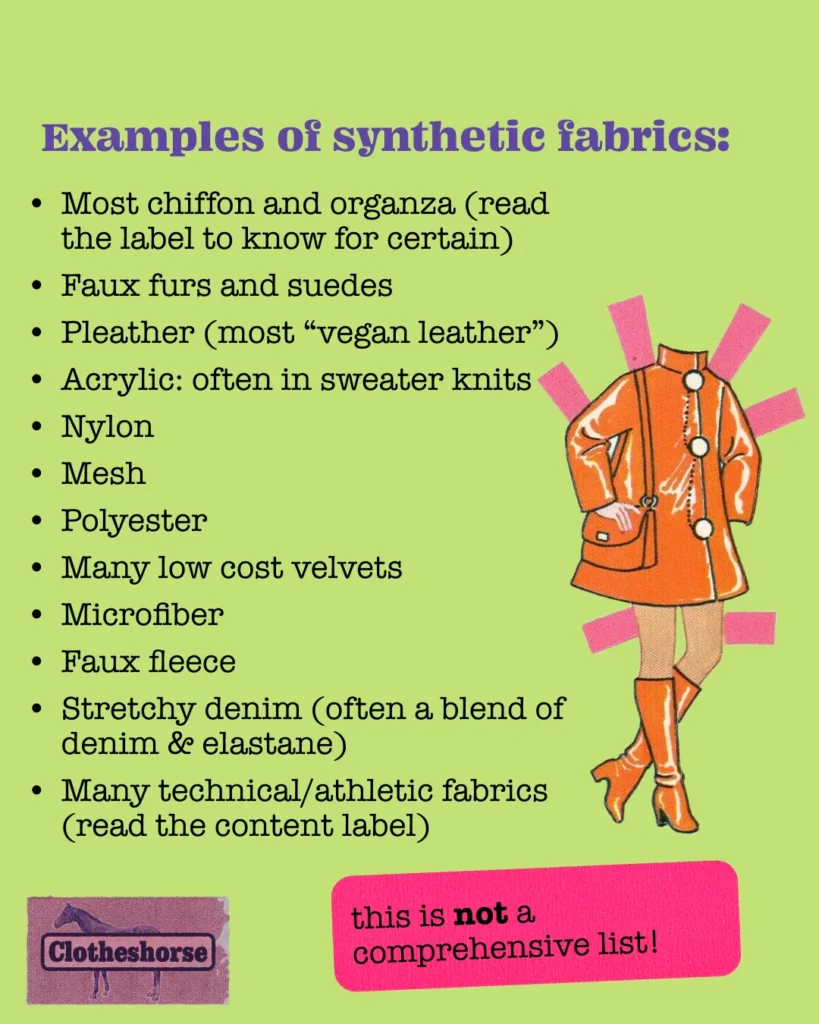
Synthetic fabrics are not biodegradable. They are made from petroleum products (fossil fuels), in a chemical reaction that requires quite a bit of energy. More simply: synthetic fabrics are made from oil.
Producing these plastic-based fibers for textiles uses an estimated 342 million barrels of oil every year.
Synthetic fabrics are made of the same plastic polymer fibers as water and soda bottles (and any other plastic item).
To turn these plastic fibers into fabric, the plastic is heated and forced through spinnerets. The fibers are stretched to five times their length, typically combined into yarn, and then knitted or woven into the fabric.
Often these plastic fibers are blended with natural fibers like cotton, linen, and wool. Read those labels!
Remember, the fast fashion business model means making the maximum profit off of every item while still offering DEALZ DEALZ DEALZ.
Simply put: synthetic fabrics are cheaper than natural fibers. And they can be produced rapidly, while natural fiber production is impacted by weather and soil.
Washing synthetic clothing causes it to shed microplastic fibers, which gradually make their way into the oceans via your plumbing and then waterways. More sophisticated water treatment facilities DO have filters to catch a lot of this. Find out if your local water treatment facility does.
“Loosened” microplastics will continue to shed as you wear the clothing, immediately entering the ecosystem. However, the longer you own something and the more you wear it…it WILL shed less microplastics with each wear. One more reason to be a proud outfit repeater!
Fortunately, there are things you can do to help!
First things first: please do NOT panic and throw out all of your clothing made of synthetic fabric. Those garments required a lot of resources to create and we need to get maximum use out of them!
Wash less often. Not everything needs to washed after every wear! Less washing=less microplastics released.
Hand wash when possible and use a shorter washing cycle at a lower temperature. A longer wash cycle=more microplastics released.
Do a full load instead of a half load. More empty space=more friction=more microplastics released.
Use a microplastic capturing bag or ball: Cora Ball Guppyfriend
The irony of synthetic fabrics? While synthetic fabrics will spend centuries in the landfills, they are often very delicate and prone to damage.
That means…read those content/care labels and handle with care!
Once again, try not to wash with every single wear. Sometimes that’s just not an option, but when it is, save yourself a chore!
Work to remove stains. Let’s get maximum wear out of these fabrics!
If you want to share your opinion/additional thoughts on the subjects we cover in each episode, feel free to email, whether it’s a typed out message or an audio recording: amanda@clotheshorse.world
Deco Denim is a startup based out of San Francisco, selling clothing and accessories that are sustainable, gender fluid, size inclusive and high quality–made to last for years to come. Deco Denim is trying to change the way you think about buying clothes. Founder Sarah Mattes wants to empower people to ask important questions like, “Where was this made? Was this garment made ethically? Is this fabric made of plastic? Can this garment be upcycled and if not, can it be recycled?” Signup at decodenim.com to receive $20 off your first purchase. They promise not to spam you and send out no more than 3 emails a month, with 2 of them surrounding education or a personal note from the Founder. Find them on Instagram as @deco.denim.
Selina Sanders, a social impact brand that specializes in up-cycled clothing, using only reclaimed, vintage or thrifted materials: from tea towels, linens, blankets and quilts. Sustainably crafted in Los Angeles, each piece is designed to last in one’s closet for generations to come. Maximum Style; Minimal Carbon Footprint.
Republica Unicornia Yarns: Hand-Dyed Yarn and notions for the color-obsessed. Made with love and some swearing in fabulous Atlanta, Georgia by Head Yarn Wench Kathleen. Get ready for rainbows with a side of Giving A Damn! Republica Unicornia is all about making your own magic using small-batch, responsibly sourced, hand-dyed yarns and thoughtfully made notions. Slow fashion all the way down and discover the joy of creating your very own beautiful hand knit, crocheted, or woven pieces. Find us on Instagram @republica_unicornia_yarns and at www.republicaunicornia.com.
Cute Little Ruin is an online shop dedicated to providing quality vintage and secondhand clothing, vinyl, and home items in a wide range of styles and price points. If it’s ethical and legal, we try to find a new home for it! Vintage style with progressive values. Find us on Instagram at @CuteLittleRuin.