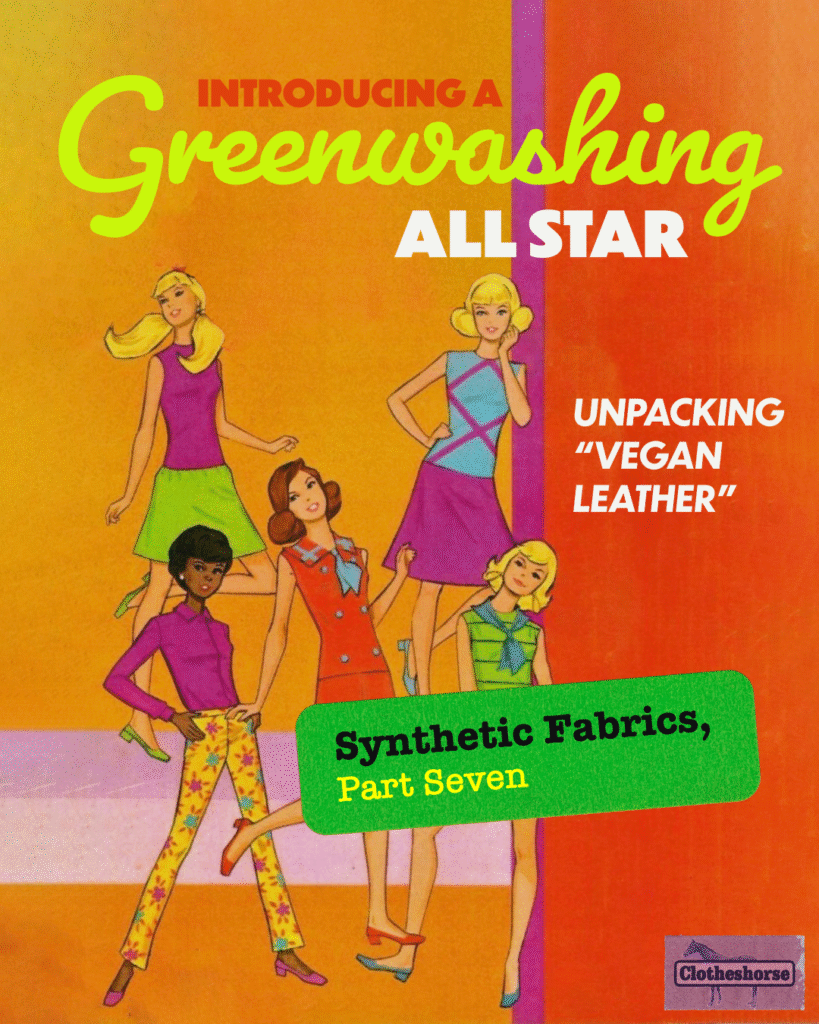
When we talk about the reality of “vegan” textile options like faux fur or faux leather, it is not a “gotcha” moment attack on veganism. A plant-based diet (if done thoughtfully) can have a lower environmental impact than diets that contain animal products.
What you eat is a very personal decision…and clothing should be approached the same way!
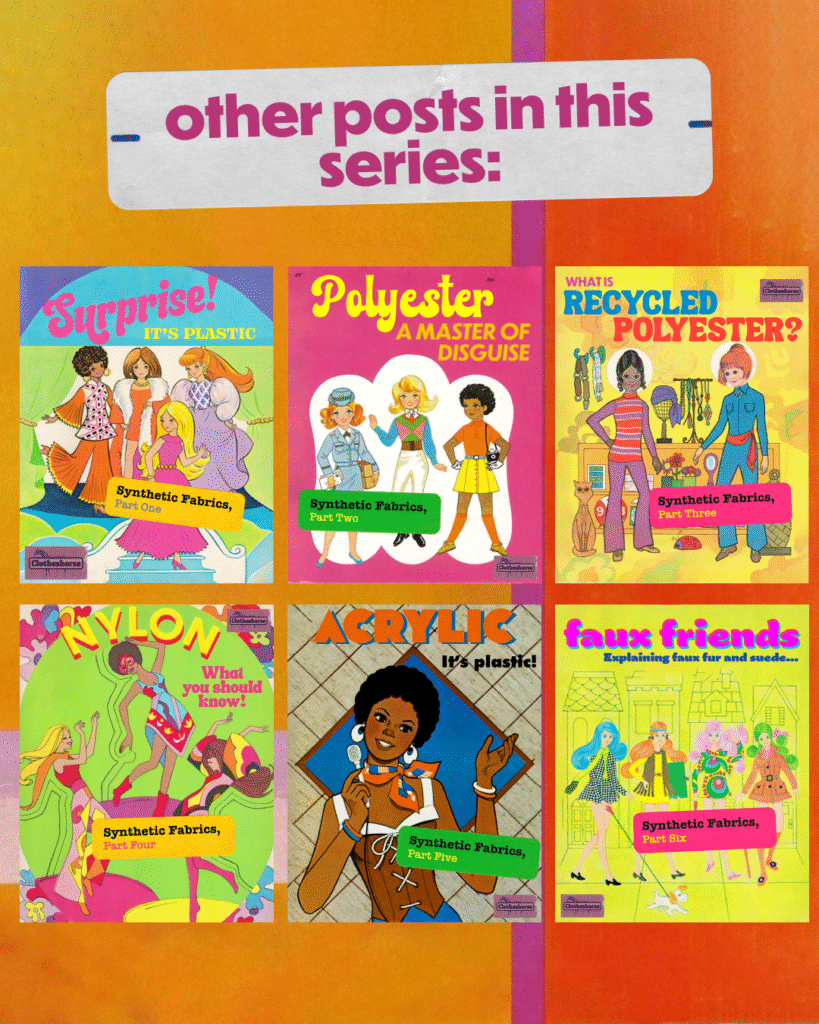
This post is part of a longer series unpacking and explaining synthetic fabrics…that is why we WILL not be digging into real leather.
In most cases, it’s plastic…especially if you are buying it from a mass retailer, any fast fashion brand, or at a lower price.
Yes, there are some non-plastic options out there, but they have not been adopted in a significant way by the fashion industry.
Why? Because they are more expensive. And in a fast fashion world–where big brands count on selling a significant amount of product on sale at a high profit margin–the math just doesn’t math for better leather substitutes.
That is unfortunate, because if big brands with more resources ($$$) supported development and production of high quality, non-plastic leather substitutes, customers (aka you and me) would have many more options.
Once upon a time, “vegan leather” was called “pleather” and it could only sell at a really low price. Fake leather coats and other clothing were frowned upon and considered “cheap.”
Rebranding faux leather as “vegan leather” allowed retailers to imply that it was a “sustainable” choice. And it’s not like these brand explained that they were really selling plastic clothing, right?
The illusion of sustainability also made it possible for retailers to charge higher prices for items made of faux leather, making it extremely profitable.
Customers also overconsumed fake leather because the implied sustainability made it feel guilt free.
Production of most faux leather begins with a fabric base (often polyester). The fabric is coated with a “leather like” finish and texture with wax, dye, and polyvinyl chloride (PVC) or polyurethane (PU).
These “layers” give the material both the drape and structure of real leather.
Most “natural” versions of artificial leather will use plant fiber as the base, but they are still treated with PU or PVC coating. Even current versions of “mushroom leather” contain PU or other binding materials that prevent them from being fully biodegradable.
From a purely aesthetic perspective, PVC (polyvinyl chloride) is the best faux choice for bags/wallets because it is stiffer and more durable than PU.
But PVC has some major drawbacks: It requires the use of phthalates as a plasticizer to make the PVC more flexible. Phthalates are harmful to humans. And the process of manufacturing PVC creates carcinogenic byproducts called dioxins.
From its creation to its final resting place in landfills, PVC releases toxic fumes that have been linked to respiratory, neurological, and reproductive health issues.
Yes, technically polyurethane (PU) is “better” than PVC. But…it’s also plastic. PU is made from the same polymers that are used to make foam cushions, insulation, adhesives, and athletic shoes.
This means that PU is not biodegradable. It’s also not recyclable thanks to the “layering” of materials required to create faux leather. This means that when you are done with a PU garment, it sits in the landfill for centuries.
Producing PU (like all plastics) requires fossil fuels and a great deal of energy.
Apple leather: about 50% fossil-fuel derived (so yeah, not biodegradable).
Cactus leather: also partially fossil-fuel derived, so it’s not biodegradable.
Pineapple leather: yes, also made with fossil fuels (are you seeing a pattern here?)
Mushroom leather: I was unable to find a fully biodegradable version that did not require additional treatment/coating for long term use.
MIRUM: The Stella McCartney SOS Fund actually invested in developing the first ever, plastic-free and fossil fuel-free leather substitute, made in Illinois by Natural Fiber Welding. Even the fabric backing is made of cotton, instead of polyester! MIRUM is not widely available and it is rather expensive…but that is something that could change if the rest of the industry invested in its production.
Ironic, right? Sure, faux leather will linger in landfills for centuries, but it doesn’t hold up very long to regular use. But does that really surprise you? Fast fashion loves selling us things that we will have to replace very soon.
It’s VERY vulnerable to moisture. That’s because water (even in the air) can weasel its way between the layers of the material. This leads to flaking, cracking, and peeling.
It’s very important that you keep faux leather clothing and shoes as dry as possible.
I used to wear a lot of faux leather because it felt like the best match for my personal values. Now my wardrobe is a mix of secondhand leather and faux leather items I have had for a long time.
My advice? KEEP IT DRY!
Store in a dry place. No damp basements! And don’t hang it in a steamy bathroom. If someone spills a drink on you, dry it ASAP.
Going to be out in the rain? Wear something else. I would wear rubber rain boots outside and change into to my faux leather shoes indoors.
Spot clean (no washing machine)!
There is no miracle fabric that we can over consume without repercussion. My hang up with “vegan leather” is that for people who don’t understand what it really is may read/hear “vegan” and assume that it IS a material that can be over consumed. And that’s the intent of that renaming of pleather!
I also hesitate to refer to pleather as “cruelty free,” because all living things (including humans) suffer the repercussions of its production and its after life.
I am extremely frustrated with a system that gives us only options that contribute to deforestation (leather), poison the earth (both faux leather and real leather) and cause suffering (both faux leather and real leather). Better options exist, but the industry refuses to fund them.
Ultimately whether you choose real leather or the faux version, it’s a personal choice based on your own values and priorities. There is no perfect fabric, only fabrics that best match you and your lifestyle.
Unhappy with the binary of leather/faux leather? Then skip them all! Consider waxed or regular canvas for shoes and bags. Wear a jacket or pants made of other materials! And does anyone really need leather-y dresses and skirts?
No matter what you choose to wear, MAKE IT LAST! Mend it. Rehome it thoughtfully. Shop #SecondhandFirst. And don’t buy things you can’t see yourself wearing over and over again.
Because nothing is disposable.
Images are from the 1971 “World of Barbie” paper doll book.
Your list may vary (because values are extremely personal):
Amazon, Walmart, Target, SHEIN, Temu…basically any company with opaque supply chains and labor issues.
Companies like Trader Joes and Starbucks who engage in anti-union tactics.
Brands who refused to #PayUp on orders cancelled in 2020: all the URBN brands, American Eagle, Aerie, TJ Maxx, Home Goods, Marshalls, Ross, Kohl’s, Forever 21, and more.
Any company with an obvious political stance that does not fit my own values. Yeah, that means I won’t be renting a truck from the U-Haul place in my town with a massive Trump sign. Definitely not buying cookies from this terrible viral cookie place here in Lancaster County.
That’s just the beginning of my list. Most importantly, I try to shop secondhand first. And when I can’t do that, I start by looking for something local from a small business.
My thought process as I make decisions about where and when to shop:
First things first: do I really need this? Is it more of a want?
If it’s clothing: why do I need it? When and how will I wear it? Am I prepared to care for it properly and mend it when necessary?
If it’s not clothing, where will it live in my home? Can I see myself using this thing for a long time?
Can I find it secondhand? Often I’ll look online and in person for this item, for days, weeks, even months (if it is not urgent).
If I can’t find it secondhand, can I find it from a local small business? That means my money will stay within the community.
If I can’t find it locally, can I find it elsewhere from a small business? My money has more immediate impact with a small business.
If I still can’t find it, but definitely need it…then I’ll buy it elsewhere.
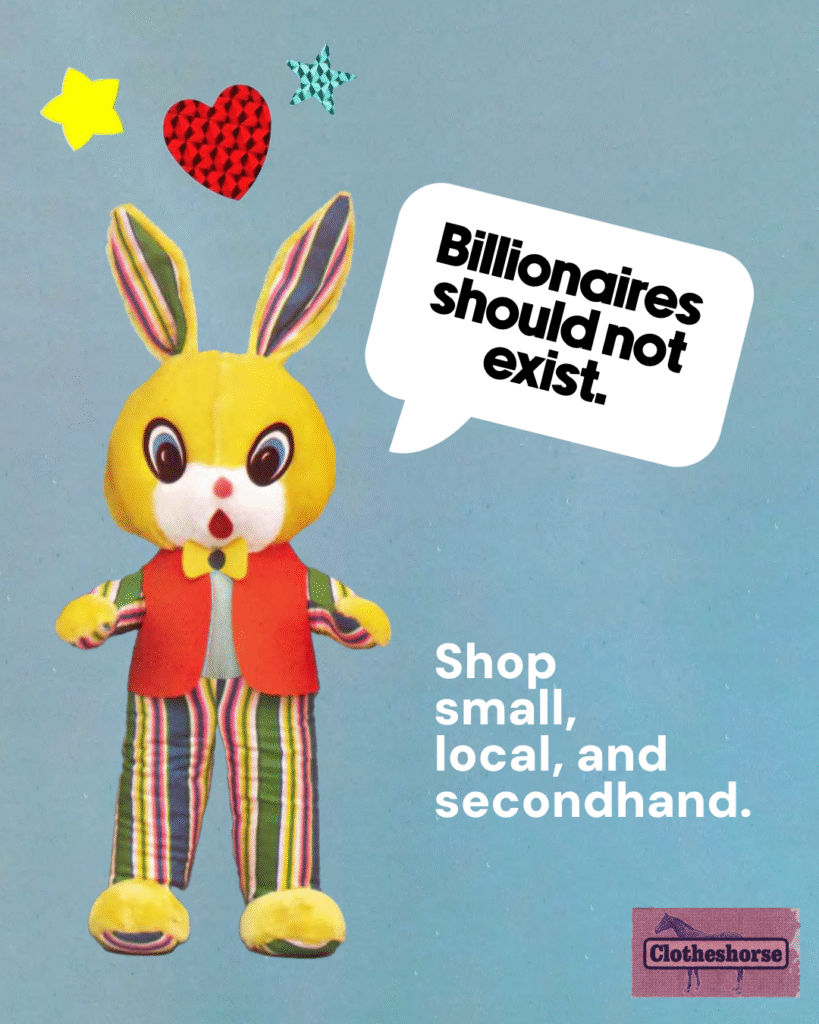
The last thing I want to add here: odds are good that your favorite small business isn’t planning on buying an election, gutting the federal government, or blasting rockets into the atmosphere. So shop small when you can!
If you want to share your opinion/additional thoughts on the subjects we cover in each episode, feel free to email, whether it’s a typed out message or an audio recording: amanda@clotheshorse.world
Deco Denim is a startup based out of San Francisco, selling clothing and accessories that are sustainable, gender fluid, size inclusive and high quality–made to last for years to come. Deco Denim is trying to change the way you think about buying clothes. Founder Sarah Mattes wants to empower people to ask important questions like, “Where was this made? Was this garment made ethically? Is this fabric made of plastic? Can this garment be upcycled and if not, can it be recycled?” Signup at decodenim.com to receive $20 off your first purchase. They promise not to spam you and send out no more than 3 emails a month, with 2 of them surrounding education or a personal note from the Founder. Find them on Instagram as @deco.denim.
Selina Sanders, a social impact brand that specializes in up-cycled clothing, using only reclaimed, vintage or thrifted materials: from tea towels, linens, blankets and quilts. Sustainably crafted in Los Angeles, each piece is designed to last in one’s closet for generations to come. Maximum Style; Minimal Carbon Footprint.
Republica Unicornia Yarns: Hand-Dyed Yarn and notions for the color-obsessed. Made with love and some swearing in fabulous Atlanta, Georgia by Head Yarn Wench Kathleen. Get ready for rainbows with a side of Giving A Damn! Republica Unicornia is all about making your own magic using small-batch, responsibly sourced, hand-dyed yarns and thoughtfully made notions. Slow fashion all the way down and discover the joy of creating your very own beautiful hand knit, crocheted, or woven pieces. Find us on Instagram @republica_unicornia_yarns and at www.republicaunicornia.com.
Cute Little Ruin is an online shop dedicated to providing quality vintage and secondhand clothing, vinyl, and home items in a wide range of styles and price points. If it’s ethical and legal, we try to find a new home for it! Vintage style with progressive values. Find us on Instagram at @CuteLittleRuin.