A while back, someone who found me on Instagram was trying to convince me that yes, some fabrics/fibers SHOULD be overconsumed. They went as far as emailing me to explain that I just don’t know much about farming, offering to spend some time educating me about it. Before I got annoyed and ended the conversation, I explained that even overconsumption of the wool her farm was producing had an impact on the planet: the water used in dyeing, the packaging and energy required to ship packages to customers to other places, even just the use of farmland. And while yes, the wool from her farm was significantly superior to polyester, no one needs 50 sweaters that they barely wear.
That’s the thing about fast fashion and us: we have to break habits and think about things differently. Yes, of course companies need to stop operating with cruel recklessness. But we also have to get comfortable with less shopping and longer relationships with our stuff. Companies have entire systems and processes to dismantle….and we have habits and ways of thinking to rework. And yeah, it takes effort from all of us!
There is no simple “best” fabric because they all have an impact.
Anyone who tells you that _______ is the best fabric is either oversimplifying or trying to sell you something via greenwashing.
Even “more sustainable” fabrics can contribute to deforestation, divert freshwater from people/animals, require toxic chemical treatments, and take up agricultural space that could be used for food.
It’s important for you to know the fabric you are buying. Understand its lifespan! If that fabric is synthetic, it’s going to be on this planet for centuries. Buying it isn’t a decision to take lightly.
If it’s a synthetic fabric, recognize the chemicals and energy used to create it.
Even if it’s 100% cotton, take a moment to visualize the time, resources (like water), and humans involved in making that garment.
Taking that time makes impulsive purchases a lot less impulsive.
Ideally the answer should be “YES” to both questions, but the fabric/garment choices will be different for all of you!
Slow fashion means slowing down the rate at which we move through clothing...that means shopping more slowly (giving ourselves time to think about what we buy) and wearing our clothes for as long as possible.
And yes, sometimes you just won’t wear an item for years because life is full of changes and surprises.
If you live in New Orleans where it’s humid and warm, a poly chiffon puff dress probably isn’t a great idea. If you live somewhere cold, maybe pass on cropped pants or silky tank tops.
Be honest with yourself! And remember…one of the keys to the slow fashion way of life is wearing what makes you feel your best! Dressing for your climate is an important part of that. And yes p.s. this is a lesson I have learned the very hard way. Why was I going out in cold NYC winter nights with bare legs?!
Are you super sweaty? Prone to overheating? Then maybe an acrylic sweater is a bad idea.
Sensory issues with certain textures? Skip them!
Do you get a rash from wool? I do! Even between my fingers and on my face. So I don’t wear wool, even though it lasts forever and is biodegradable.
Identify your deal breakers. A loved garment is a comfortable garment!
If you don’t have space for a drying rack or a wash line, this is something to consider!
If you’re working two jobs and/or caring for loved ones, then you might not have time for handwashing or ironing. And that’s fine, too.
Once again, be honest with yourself!
If it’s faux fur, you need to brush it off before you leave the house and toss the loose “hairs” in the trash.
For other synthetic clothing, are you willing and able to change up your laundry routine, launder less often, and invest in a microplastic trapping ball, bag, or filter? These are all things to consider.
Being a responsible, thoughtful person is hard work sometimes!
Will you keep your faux leather dry? Will you be careful around fences, hot coffee, spaghetti buffets, and paintball battles? Because that’s how you know you’re ready to make a commitment!
The right fabric for you = a longterm relationship.
I know this feels like a lot to consider…but making thoughtful decisions about what we buy and wear is just one of the radical and impactful things we can do in our day-to-day lives!
That’s right…it probably seems like a small thing, but being true to ourselves is a radical act in the fast fashion era!
Fast fashion prefers that you opt for trends and hot deals over what you actually want to wear. That drives sales (and fills up the landfills a lot faster).
So do something radical: wear what you like, not what someone is telling you to like!
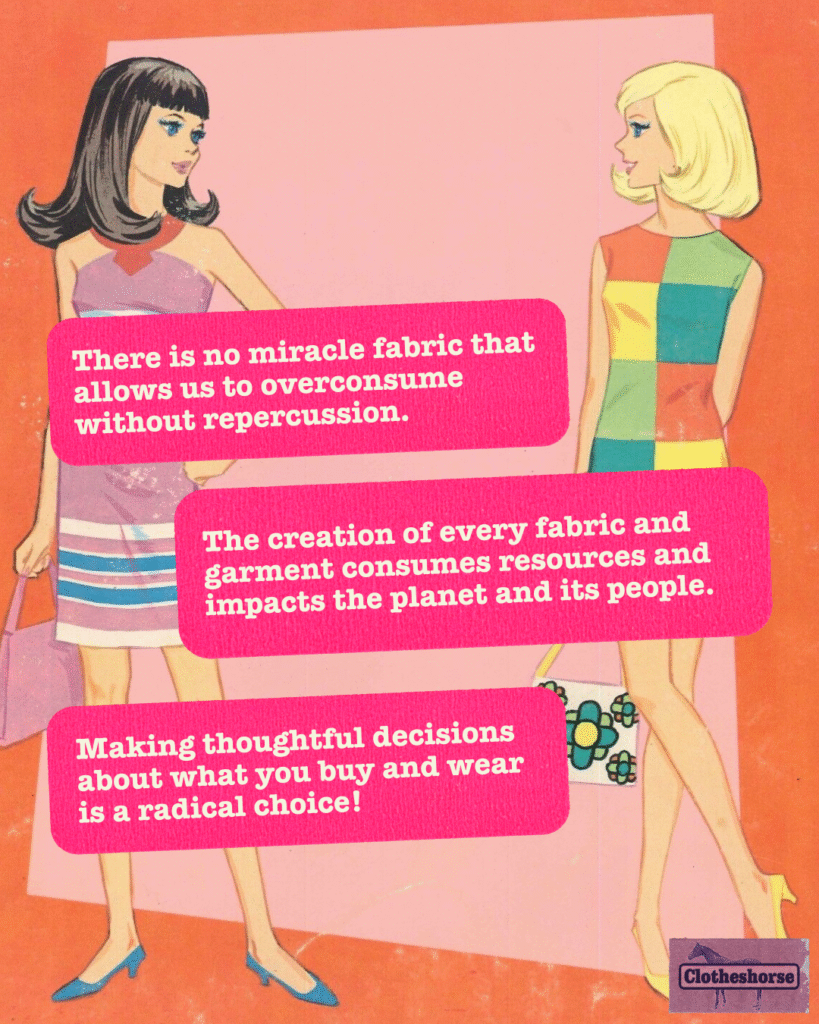
Graphics in this post are from the 1967 Francie and Casey paper doll book. Apparently Francie was Barbie’s “mod” cousin and Casey was Francie’s fun friend.
If you want to share your opinion/additional thoughts on the subjects we cover in each episode, feel free to email, whether it’s a typed out message or an audio recording: amanda@clotheshorse.world
Deco Denim is a startup based out of San Francisco, selling clothing and accessories that are sustainable, gender fluid, size inclusive and high quality–made to last for years to come. Deco Denim is trying to change the way you think about buying clothes. Founder Sarah Mattes wants to empower people to ask important questions like, “Where was this made? Was this garment made ethically? Is this fabric made of plastic? Can this garment be upcycled and if not, can it be recycled?” Signup at decodenim.com to receive $20 off your first purchase. They promise not to spam you and send out no more than 3 emails a month, with 2 of them surrounding education or a personal note from the Founder. Find them on Instagram as @deco.denim.
Selina Sanders, a social impact brand that specializes in up-cycled clothing, using only reclaimed, vintage or thrifted materials: from tea towels, linens, blankets and quilts. Sustainably crafted in Los Angeles, each piece is designed to last in one’s closet for generations to come. Maximum Style; Minimal Carbon Footprint.
Republica Unicornia Yarns: Hand-Dyed Yarn and notions for the color-obsessed. Made with love and some swearing in fabulous Atlanta, Georgia by Head Yarn Wench Kathleen. Get ready for rainbows with a side of Giving A Damn! Republica Unicornia is all about making your own magic using small-batch, responsibly sourced, hand-dyed yarns and thoughtfully made notions. Slow fashion all the way down and discover the joy of creating your very own beautiful hand knit, crocheted, or woven pieces. Find us on Instagram @republica_unicornia_yarns and at www.republicaunicornia.com.
Cute Little Ruin is an online shop dedicated to providing quality vintage and secondhand clothing, vinyl, and home items in a wide range of styles and price points. If it’s ethical and legal, we try to find a new home for it! Vintage style with progressive values. Find us on Instagram at @CuteLittleRuin.